THE RAPTURE IN 2026:
DOES THE BIBLE TEACH IT?
By Rupert Raynar
Copyright © 2026 Rupert Raynar. All rights reserved
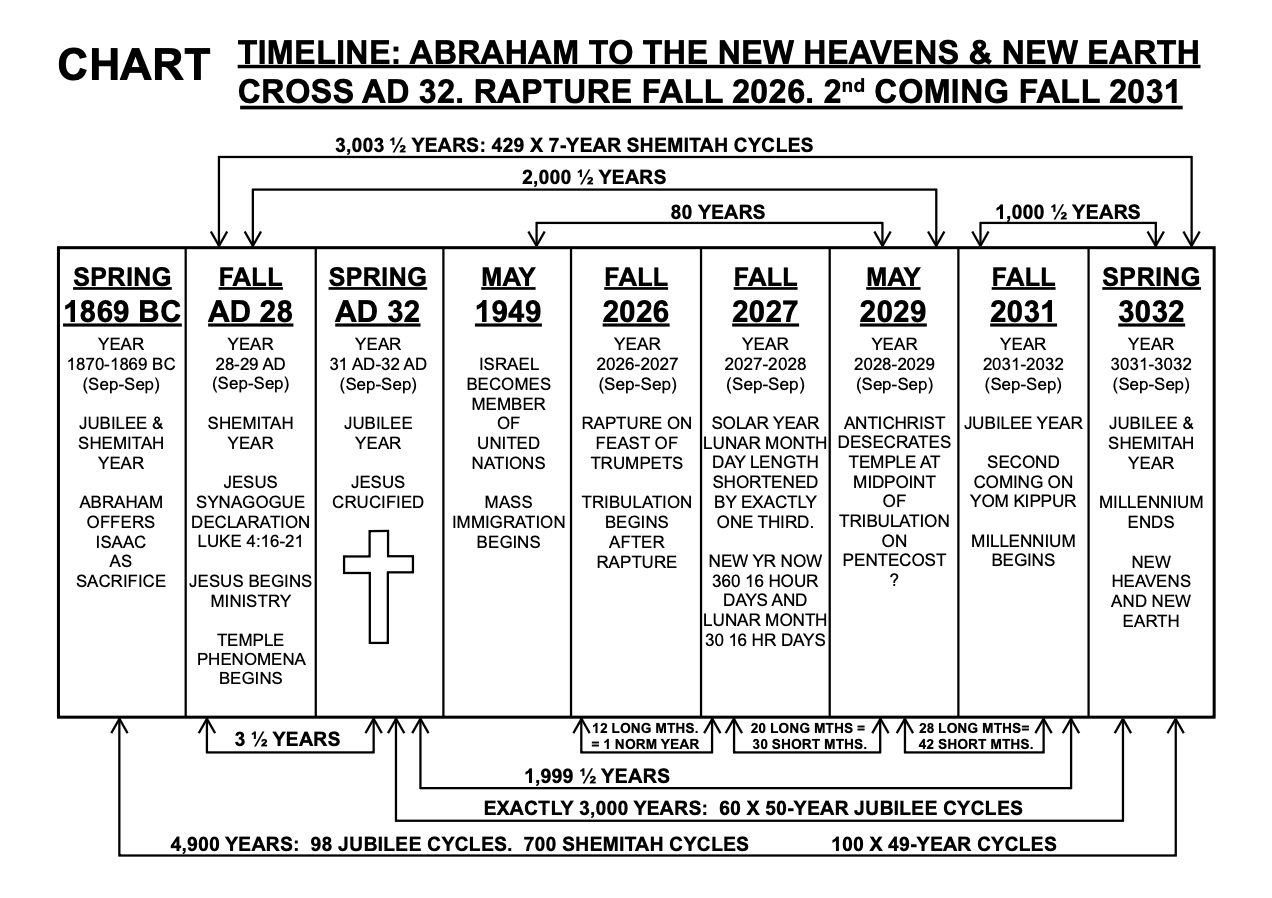
N.B. When reading this, Please View Timeline Chart Here
The Rapture In 2026
Copyright © 2026 Rupert Raynar. All rights reserved
N.B. When reading this, Please View Timeline Chart Here
My Dear Friend,
From the title of this article, you would be correct in thinking that I will be dealing with the subject of the “Rapture” from the standpoint of the Bible, for if we stray too far from Scripture, then whatever thoughts we might have on the matter, they can never amount to anything more than unhelpful speculation.
Now, many people – even those with a limited knowledge of “end-times” events – will be familiar with the verse in Matthew 24:36 where Jesus says, “of that day and hour knoweth no man, no not the angels of Heaven, but my Father only.” Thus, because of that one statement by the all-wise Son of God, most people are therefore reluctant to consider that it might be possible to discern even a season when the Rapture may be more likely. Instead, the accepted wisdom – including from well-versed theologians – tells us that Christ’s Return for His “Bride” (i.e. the true Church of born-again Believers) can happen at any moment with no particular time more likely than any other. Hence, this whole doctrine of the “imminency” of the Rapture has been a mainstay of end-times prophecy for the past 2,000 years. For hasn’t every generation since Jesus ascended, thought that He might return in like manner in their lifetime?
Well, I am of course aware of Jesus’s Matthew 24:36 statement, and the teaching that if God had wanted us to know the exact timing, then it would be clearly delineated in Scripture. And you have to admit, it would have been strange if a particular year, for instance, had been mentioned, for then Christians might then have used it as a reason for not being prepared to meet the Lord today. For one thing, keeping the time hidden has meant that every generation for the past 2,000 years has been able to enjoy the blessed hope that the Lord could come back at any moment, and thereby rescue them from the intense persecution that many have had to endure, and continue to endure, as followers of Christ down the ages. In short, believing Jesus could come back today inspires us both to be hopeful, yes, but also holy.
So, then, surely, based on what I’ve just said, that must bring closure to this whole subject of whether it is possible to know, in advance, the most likely season for the Rapture. For it must be apparent that the Bible consistently avoids any contradiction of Jesus’s statement, by not giving any clues regarding this entire matter. Well, my first reaction is to point out the often-mentioned truth that about ¼ of the entire Bible is devoted to prophecy, and most of that concerns the events happening at the time of Christ’s Second Coming.
Thus, clearly, this whole subject is both of massive interest and importance to God, and so it should also be to us who read and study His Word. Because, if God had not wanted us to pick up on the clues about Christ’s Return, then why is there so much information about it in the Scriptures?
Now, it is here that I believe it is time to comment directly on Christ’s utterance in Matthew 24:36. For, most people are unaware that Jesus’s statement is actually an “idiom” that was familiar to the Jews at that time. For it refers directly to a name given to the Jewish Feast of Trumpets by the Jews, (i.e. “No man knows the day or the hour”) because, every year – even though it always starts directly after the New Moon on “Tishrei 1” in the Fall – you cannot actually be certain that the Feast has in fact begun, because it first requires there to be an actual sighting of the New Moon in the sky above Jerusalem. For sometimes there is cloud cover, or the Moon is below the horizon, so then the start of the Feast is then delayed. So, could it therefore be that Jesus was alluding to the Rapture actually happening at some point during the Feast of Trumpets, even though the exact day cannot be known in advance? So, can you now see that if we are open to all that Scripture has to say, we might be surprised to discover that there’s a lot more to learn regarding this whole subject, than we might hitherto have first thought. Thus, I hope you will join with me in this article, as I discuss what is a vast treasure-trove of yet more clues about this whole fascinating issue. Because, after all, what could be more exhilarating and hope-filled for believers than to discover that finally we might be on the brink of the very events which Christians have – for so many generations – read about, and anticipated would happen during their lifetimes.
So, before I start talking about the Rapture in some detail, what actually are the key subjects of end-times prophecy? Well, they are: the “Rapture;” the “Tribulation;” the “Second Coming;” and then Jesus setting up His “Millennial Kingdom.”
So, let’s begin by taking the Tribulation, which is referred to as “Jacob’s Trouble” in Jeremiah 30:7, when God will pour out His wrath on a Christ-rejecting World in a similar way to when God judged the World at the time of Noah, during the great world-wide flood. (Genesis 6:5,11-13.)
As for how long the Tribulation will last, Daniel 9 gives us the answer: it will be exactly 7 years. So, what will happen during those 7 years? Well, if we turn to Matthew 24, or Luke 21, or Mark 13, as well as the Book of Revelation, we will have our answer. For there will be war, famine, pestilence, economic collapse, crop failure, earthquakes, asteroids, hail stones, raging fires, the pollution of all the water, as well as massive demonic activity. Half the population of the planet will die: that’s 4 billion people during those 7 years. But that is not all: the Bible says that the time will coincide with there being one World Leader, the “Antichrist,” who will, after 3 ½ years, proclaim himself to be “God,” and will demand to be worshipped as such in a newly rebuilt Temple in Jerusalem. For many will be deceived by him and his “side-kick,” the “False Prophet.” It will also be the time when pretty much the whole World will turn against Israel, before finally, after 7 years, Christ will return at His “Second Coming” to judge the Nations. However, many will “call upon Jesus” to save them, including a third of all Israel. For they will finally realise that their true promised Messiah is not the Antichrist, but Jesus Christ, who died for them when He first came 2,000 years ago.
Events will then end with the final battle of “Armageddon,” when God’s enemies, as well as Israel’s, are finally destroyed, along with the Antichrist and the False Prophet. Jesus will then set up His Millennial Kingdom on a restored Earth wherein dwelleth righteousness. Then, 1,000 years later, comes the “Great White Throne Judgment” of unbelievers (Revelation 20;11-15), and the new Heavens and the new Earth which will last for eternity. (Rev. 21 and 22.)
Now, there is of course a lot more I could say, but the primary topic I want to consider is the “Rapture of the Church” (the Church consisting solely of “born-again” Christians), which most theologians believe will take place right before the 7-year Tribulation begins. Now, there is a precedent for God judging the whole World for its wickedness, and that was in the great World-Wide Flood of Genesis 6-8 when, you will remember, everyone on the Earth perished except for Noah and his family. That’s right, God saved righteous Noah by providing an Ark of safety, and God will do the same again next time He devastates and judges the World. And that period, as I’ve just said, will be the 7-year Tribulation. The only thing is, directly before that starts, every person who “believes in Jesus,” will be taken from the Earth directly to Heaven. Thus, every “believer in Jesus” will be protected from the devastation that’s coming, by being directly removed from the danger in the “Rapture.” For, it is a unique, once-and-for-all-time event, when God – as I summarized earlier – “snatches away” supernaturally, the bodies of “believers” from the Earth into Heaven, without them dying first. I know that may sound like a fantasy to you, and not something any “right-minded person” would ever believe in, but I must answer that by saying that it is definitely taught in the Bible, so it will happen!
Now, the two main scriptures concerning the Rapture are to be found in 1 Thessalonians 4:16-18, and in 1 Corinthians 15:51, 52. The first scripture reads, “For the Lord himself shall descend from heaven with a shout, with the voice of the archangel, and with the trump of God: and the dead in Christ shall rise first: then we which are alive and remain shall be caught up together with them in the clouds, to meet the Lord in the air: and so shall we ever be with the Lord. Wherefore comfort one another with these words.” The second scripture reads, “Behold, I shew you a mystery; we shall not all sleep, but we shall all be changed, in a moment, in the twinkling of an eye, at the last trump: for the dead shall be raised incorruptible, and we shall be changed.”
So, all well and good. But how can we be sure that that will take place before any wrath from God is poured out in any kind of tribulation? Well, once again, Scripture holds the key, for the principle that God never directs His Divine Wrath against those He highly favours, (i.e. those He has already forgiven) is a repeated theme throughout the Bible. Thus, Paul in 1 Thessalonians 5:9 says that God has not appointed us (those who are saved) to wrath, but to obtain Salvation by our Lord Jesus Christ. How come? Because Jesus took God’s wrath in the place of believers when He died on the Cross, and God does not punish sin twice over. An example of this was just “Lot,” whom God made sure was out of the city of Sodom, before He destroyed it with fire and brimstone (Gen 19).
And as we saw earlier, the same thing applied to righteous Noah and his family, who were kept safe from divine punishment during the universal flood that destroyed the entire population of the Earth. Thus, if the “Church,” which is made up of forgiven believers, is not raptured before the Tribulation starts – but instead sometime later e.g. mid-way or at the end – then this would be a departure from the Biblical principle we’ve just been looking at. As for Jesus, He makes a point of referring both to Noah and to Lot in Luke 17:26-30, where He says that as it was in their day, when judgment came, so shall it also be “when the Son of Man is revealed.”
However, that is not the only reason to believe in a “Pre-Trib” Rapture, for there is also no mention of the “Church” being on the Earth when God’s judgment gets underway. Instead, in Chapters 4 and 5 of Revelation, the Church is already in Heaven. Thus, I think we can conclude that every true Christian will escape (via the Rapture) from what is, after all, the pouring out of God’s righteous anger against a Christ-rejecting World, and not against true believers.
It is here that I would like to mention the teaching on this whole subject by “Dr. Andy Woods,” who strongly believes the Bible does indeed teach such a Pre-Trib Rapture. In particular, can I recommend his YouTube video below:
“7 REASONS TO TRUST THE PRE-TRIB RAPTURE”
CHANNEL: DR. ANDY WOODS
So, what time of year might we expect the Rapture? Well, let us go to Leviticus Chapter 23, where we will discover that God instructs the Jewish people, through Moses, that they are to commemorate 7 Feasts throughout each and every year going into the future. God then makes it clear that the exact timing of each of these feasts is to be done primarily using the natural phases of “New-Moon” and “Full-Moon,” especially in the Spring and in the Fall of each year. Now, please note: even though these “Feasts” are “of the Lord,” (Lev 23:1,4) I will refer to them in future as “Jewish,” to distinguish them from the “Christian” events which will later fulfil them.
Now, let us look at the first feast day, that of “Passover,” when the Jews in Leviticus 23 are instructed to kill a “Passover Lamb,” like they did during their flight out of captivity in Egypt. It was then that, before their escape, a lamb was killed (one per household), and its blood was put on the door-posts and lintel of the dwelling, Thus, the Lord could then “pass over,” and do no harm to those Jews displaying and trusting in the blood: that is unlike the blood-absent dwellings of the Egyptians, where the first-born children, as well as animals, were slain by the Lord.
And thus, the Feast of “Passover” is still celebrated on the 14th day of the Jewish month of “Nisan” in the Spring. Now, the first day of that month – like every month in the Jewish calendar – is determined by a “New Moon,” and similarly, the 14th day always coincides with a “Full Moon.” As for when the month of Nisan begins on its New Moon, it is, put simply, around the Spring Equinox. It’s actually more complicated than that, but I won’t go into the details as it’s not necessary.
However, over the course of millennia, there have been at least four different calendars, so that determining on which day of the week the various feasts, including Passover, have been celebrated – and that is including those during the time of Jesus – is not easy for us to determine. Now, I mention this because, as I will show later, it will affect any calculation we might make regarding the exact timing of Jesus’s Crucifixion. But more about that later.
But to get back to the 7 annual Feasts in Leviticus 23: there are 3 in the Spring, 3 in the Fall, and one in between, in the Summer. And they are, as we’ve seen: “Passover,” then “Unleavened Bread,” while the third in the Spring is that of “First Fruits.” Then comes the Jewish Feast of “Shavuot,” or “Weeks,” in the Summer. And as for the 3 Fall Feasts, they are the “Feast of Trumpets;” then “Yom Kippur;” then finally “The Feast of Tabernacles.” But here is where things begin to get really interesting, because the 3 major Christian events that happened during the Spring, approx. 2,000 years ago (around AD 32), happened in sequence, on those particular Jewish Feast Days as I’ve just mentioned. But what is amazing is that Jesus fulfilled every one of them on the very day they happened. Thus, Jesus was killed on “Passover;” He was in the tomb on “Unleavened Bread;” and He rose on “First Fruits.”
So, where am I going with all this? Well, in the same way that those first 3 Jewish Spring Feasts were fulfilled exactly, and in sequence, on the very day – in the 3 major Christian events 2,000 years ago – we can be sure that the last 3 remaining Jewish Feasts occurring in the Fall, will also be fulfilled on the very day, and in sequence, by the 3 remaining major Christian events yet to happen. Thus, we can be confident that the next event will be the “Rapture” taking place right before the 7-year Tribulation begins, on the Jewish Feast of Trumpets. Then, 7 years later, at the end of the Tribulation, there will be the next major event – Christ’s “Second Coming” – which will occur on the next Fall Feast of “Yom Kippur” (or Day of Atonement). Then, finally, several days later, Jesus will set up His Millennial Kingdom on the Earth, coinciding exactly with the last Fall Feast, “The Feast of Tabernacles.”
So, what about the “middle feast?” For that happens in the Summer between the 3 already fulfilled Jewish Feasts in the Spring, and the 3 yet-to-be-fulfilled Jewish Feats in the Fall. Well, before we take a look at that Summer Feast, I want to stress that Jesus fulfilled the 3 Jewish Spring Feasts completely, and exactly, on the very day, 2,000 years ago. And thus, we can expect Jesus to fulfil the remaining 3 Jewish Feasts in the Fall some time in the future. For, God has 3 major Christian events on His calendar (as I said a moment ago), which God has planned Jesus to fulfil.
And so, the middle Summer Jewish Feast of the Lord is “Shavuot” or “Weeks,” which the Jews celebrate on the sixth day of the Hebrew month of “Sivan” (in late May or early June), and which is 7 Sabbaths after “First Fruits,” i.e. on the fiftieth day. (See Leviticus 23:15, 16). And as for its significance, it commemorates the anniversary of the day God gave the “Torah” to the entire Israelite Nation assembled at “Mount Sinai.” And its Christian fulfilment? That took place on the same day as that Jewish Feast, when the Holy Spirit came down and which God gave to Christians on “Pentecost,” again on the fiftieth day after Jesus rose from the dead. For, Jesus’s “Resurrection Day,” you will recall, also coincided with the Jewish Feast of “First Fruits,” as we saw earlier. Not only that, we can also make the observation that the Holy Spirit’s coming was designed by God to help every Christian believer during the years between when Christ left the Earth, after His First Coming, and when He returns to the Earth, at His “Second Coming,” 2,000 years later.
So, let’s return to the subject of the “Rapture,” and when it might happen, for I suggest we’ve now narrowed it down to the Jewish Feast of Trumpets in the Fall. But wait! That’s all well and good, but we don’t know which Fall of which year. For after all, didn’t Jesus say that “no man knows the day or the hour,” (Matt. 24:36)? Why, yes, He did, but let us continue our study of the whole subject, with the important observation that Christ’s above statement was actually an “idiom,” used by the Jews, when referring to the annual “Feast of Trumpets.” This we looked at, if you remember, at the beginning of this article. For, as we shall see, this is the Feast most favoured by theologians, as being the one coinciding with the Rapture. The only thing is this, we don’t know which year, as I’ve said. Not only that, there is uncertainty every year when it actually occurs, because it can only begin when the actual sighting of the thin crescent of New Moon in the sky above Jerusalem (that is in the relevant month), takes place, and that can be affected by such things as cloud cover etc. Hence, the Jews refer to this Feast as “no one knows the day or the hour;” and, so hence, that statement was repeated by Jesus. So that is another reason why we cannot predict an exact moment for the Rapture in advance, even if we knew the particular year.
So, let us return again to the reasoning we deployed earlier, which, you remember, produced the high probability that the Rapture will, one year, totally fulfil the Feast of Trumpets, and on the very day. Now, it is here that I want to recommend 4 “YouTube” Videos (see below) done by “Mark Biltz,” on “The 7 Feasts of The Lord,” for they look at this whole subject in a massive amount of detail, and with many Scriptures. In fact, I don’t know anyone that has done a better job of explaining this whole issue.
“MARK BILTZ. THE FEASTS OF THE LORD. PART 1. SPRING: PASSOVER”
CHANNEL: MFA PICTURES
“MARK BILTZ. THE FEASTS OF THE LORD. PART 2. FEAST OF TRUMPETS”
CHANNEL: MFA PICTURES
“MARK BILTZ. THE FEASTS OF THE LORD. PART 3. DAY OF ATONEMENT”
CHANNEL: MFA PICTURES
“MARK BILTZ. THE FEASTS OF THE LORD. PART 4. FEAST OF TABERNACLES”
CHANNEL: MFA PICTURES
So, now let us consider some of the years favoured by theologians as being the most likely for the “Second Coming.” Because, if we know on what particular future year it will be, we can then subtract 7 years to bring us to the beginning of the Tribulation, and therefore to the Pre-Trib Rapture. But here’s the thing, those theologians also tell us that the Second Coming will take place 2,000 years after Jesus died and rose at His First Coming. So hence, if we can deduce the year of Christ’s death, we can then produce a high probability year for the Rapture.
So, why is the case so strong for there being an exact 2,000-year interval? Well, it all has to do with parallels in the Scriptures, one of the main ones being the days of Creation which pictures the total time of mankind on the Earth. For you will remember, that God created everything in 6 days and rested on the 7th. (Gen 2:1-3). Thus, God’s 6 days of work foreshadows the 6,000 years of mankind’s struggle and toil against sin, but which will be followed by a millennial, 1,000 year-long Kingdom of peace and rest on the Earth when Jesus returns. For that particular time period corresponds to God’s original 7th Day Sabbath rest after Creation. For this chronological pattern is known as the “Millennial-Day Theory,” and it was clearly in mind when Peter (in 2 Peter 3:8) clearly says that “one day is with the Lord as a thousand years, and a thousand years as one day.” See also Psalm 90:4.
So, can we say more about the span of Man’s 6,000 years of toil since Creation? Well, Genesis 6:3 also mentions that Man’s days are 120 years. If we take “years” there as referring to “Jubilees” (that being a 50-year time span), then 120 Jubilee years is 120 x 50 which equals 6,000. Also, the number 40 is significant in Scripture as a time for testing: e.g. Jesus was tempted in the wilderness for 40 days, and the Israelites were in the desert for 40 years before entering the Promised Land. Ninevah was also given 40 days in which to repent, and Jeremiah also warned the people for 40 years to repent.
Now, the “Church-Age,” since Christ died, has lasted nearly “two days” i.e. 2,000 years, or almost 40 Jubilees. So, many now expect the approaching “third day” since Christ’s First Coming to usher in Christ’s Millennial Kingdom. For, this pattern of there being an especially significant “third day” is all over Scripture. Here are just some of the references, and where they occur: Hosea 6:2; Exodus 19:10-11, 16; Joshua 1:11; Mark 14:58; Luke 13:32; 10:35.
And so, inspired by Scripture, I believe we can be fairly confident that there will be 2,000 years between Christ’s death, burial and Resurrection and Ascension, and His Second Coming. Now, we also know that before He comes there will be the 7 years of Tribulation which will be preceded by the Rapture. Thus, we might think that the Second Coming has to happen on or after 2033 because, if you subtract 7 from that particular year, you get a Rapture date of 2026, which is the earliest time for a possible Rapture because that is this year.
And so, in order to be confident of a 2033 date for the Second Coming let us try and establish the year of Christ’s crucifixion. However, it is here that Bible scholars disagree about when Jesus actually died even though we know from the Gospel of Luke that Jesus’s ministry began when He was close to 30 in the Autumn and that it lasted 3 ½ years.
So can we know the date of Christ’s birth because if we can, then we add on 33 ½ years and it should take us to the year of His death. It seems like an easy way to solve the problem. However, Bible scholars also disagree about Christ’s birth date in the same way they disagree about the Crucifixion. Hence, we seem to be no nearer to establishing when Jesus actually died. However, what we can be fairly certain of is that Jesus died no later than AD 33. Hence, if the Second Coming is 2,000 years later in 2033, and we subtract 7 years, we arrive at 2026 for the year of a pre-tribulation Rapture.
However, while 2026 might turn out to be the year of the Rapture and the beginning of the Tribulation, I believe that that 2026 date has been arrived at for many wrong reasons. So please bear with me as I will explain why.
Now, the first thing to ask is what is the evidence for an AD 33 Crucifixion date. Now it is here that I want to talk about the particular day of the week Christ’s death took place.
So, let us stick once again to a time interval of exactly 2,000 years, as we just discussed, plus the possible year for Christ’s death being in AD 33. Then, let us go right back to the Gospels to re-examine what we think we know about the exact day of the Crucifixion of Jesus. For if we do that, I believe there is an additional way we can deduce on what year Jesus really did die; that is whether it could have been AD 33.
And so, let us establish from the Bible what we can know for certain happened during the fateful last week of Christ’s life, namely: His Last Supper; His Trial; His Crucifixion; His time in the tomb, and His bodily Resurrection. First, Jesus was definitely crucified as the “Lamb of God” on Nisan 14, His death being at exactly the same time as the High Priest slaughtered the Passover Lamb on the Feast of Passover. We also know that Jesus was a full three days and three nights in the tomb before His bodily Resurrection, which was first discovered early in the morning of Sunday (the first day of the week), by the women coming to the tomb. So how can we be certain that the time in the tomb was a full three 24-hour days? Well, it is made clear by Jesus in Matthew 12:40 where He says, “For as Jonas was three days and three nights in the whale’s belly; so, shall the Son of man be three days and three nights in the heart of the earth.”
Now, traditionally, pretty much the entire “Christian” Church has celebrated Christ’s Death as if it happened on a Friday (hence “Good Friday”), and His burial that same evening. So, does that allow for a full three days and three nights in the tomb before His Resurrection some time after sunset on the Saturday? (Note: Sunday for the Jews begins – like every day – at sundown the day before i.e. sunset on Saturday. Thus, Sunday would have lasted from sunset Saturday until sunset on Sunday evening. This tradition is a throw-back to the Creation Story in Genesis where God talks about each day of Creation as beginning in the evening.)
Thus, sticking with that particular time span, Jesus could have been in the tomb – that is from Friday sunset till say Saturday sunset, or even slightly past midnight that night, and hence into Sunday morning – with a maximum number of hours of probably 30 to 36. But wait! Doesn’t Jesus expressly say that the time He will be in the “heart of the Earth” is a full three days and three nights, which is 72 hours. Thus, if you believe Jesus was telling the truth, then He can not have been crucified on a Friday.
So, why has the Church for so long held to the view that the Crucifixion did – as they see it – happen on a Friday? How could they have made such a mistake? Well, I believe the answer lies in the fact that the Gospel accounts in the Bible all state that the Crucifixion happened on the day before what the Gospel writers say was a “Sabbath.”
Now, the “weekly Sabbath” always occurs on a Saturday, the last day of the week, and which is a rest-day, when no work is done. Thus, it “appears” to make sense when the Gospel writers say that the Jews were keen to have Jesus taken down from the Cross and buried, before celebrating the Sabbath on the next day. Thus, the Church has taken that Sabbath rest-day to be on the Saturday, as I’ve just said, and which begins – again as I’ve just said – the evening before. Thus, if Jesus died on Friday during the day, then if the Sabbath mentioned in the Gospels falls on a Saturday (starting at sunset Friday), then Jesus has to be in the tomb by sunset that very day i.e. on Friday, which is after the Crucifixion ends at 3 pm and He is taken down from the Cross.
So, right there we have a problem: how can Jesus be a full three days and a full three nights in the tomb and still be crucified on the day before a Sabbath day, and then rise Saturday night into Sunday? Well, the answer is, of course, to be found by again looking carefully at God’s Word. So, let us do that by first of all considering on what day have the Jews – right back to Moses – always celebrated the one-day feast of Passover. For it is always on the 14th day of the Jewish month of “Nisan” in the Spring, with that particular day always being a “Full Moon.”
Now, for the Jews, the very next day after Passover is also a Feast Day: and it is the “Festival of Unleavened Bread,” beginning that day (i.e. the 15th day of Nisan) and lasting 7 days. And yes, the Gospel writers also speak of the Festival of Unleavened Bread. So, let us go right back to the time of Moses, that is to the only source of all the information we need regarding the Feasts of Passover and Unleavened Bread, for it is to be found in Exodus Chapters 12 and 13, and Leviticus Chapter 23.
Now, I could do a lengthy Bible study on just those three chapters but I won’t. Instead, I will distil it down to this: the Jewish Passover is always celebrated on the 14th Day of the first month of “Nisan,” which is the first month on the Jewish “Religious” Calendar, starting in the Spring. Now, every Jewish month begins with a New Moon, so the 14th Day of Nisan is always a Full Moon, and traditionally it has also occurred close to the Spring Equinox.
Now, the beginning of each Jewish “Religious” New Year in the Spring is decided, as I say, by the phase of the Moon at that particular time of year. Thus, the first day of the month of Nisan, even though it always falls on that particular New Moon, always occurs at different “time-lengths” every year from the Spring Equinox, which is fixed. Thus, the 14th Day of Nisan – which is always a Full Moon, as well as being the day on which Passover is always celebrated – will fall on different days of the week when each year comes around. Hence, the Full Moon at Passover does not continue to fall on a set particular day of the week every year, unlike, for example, the weekly Sabbath which is always on a Saturday.
Thus, the Passover celebration every year by the Jews doesn’t have to be on a fixed day; when the Church, on the other hand, celebrates Christ’s Death on the same day – i.e. a Friday – every year. Thus, our “Easter” celebrations of “Good Friday” remain on a fixed day of the week, though the Jews, as they always have, celebrate the actual Feast of Passover on the Full Moon in the moveable month of Nisan. Thus, for the Jews, that day can be any day of the week; it is not fixed like the Church has fixed the Crucifixion Day to a Friday.
So, let us look again at the chapters in Exodus (12 and 13) and Leviticus Chapter 23, and consider what the Bible also says about our other feast, the “Feast of Unleavened Bread,” which again goes right back to the time when God delivered the Jews from the hand of Pharoah in the “Exodus.” And if we do that, we discover that the Festival of Unleavened Bread lasts for 7 days, beginning on the 15th Day of the first Jewish month of Nisan, and which is the day following Passover on the 14th day of that same Jewish month. But that is not all, for the Scripture also tells us that the 1st and 7th Days of the Festival of Unleavened Bread are to be treated also as “Sabbaths” and thus as days of rest. Thus, these extra holy days of rest make up some of the extra “Sabbaths” that the Jews celebrate throughout the entire year, and which are additional to the better-known weekly Sabbaths that occur every week, and which always fall on a Saturday, the last day of the week.
Thus, when the Gospel writers say that Jesus had to be taken down from the Cross and buried before the beginning of “the Sabbath,” starting at sunset (John 19:3), the Sabbath they are referring to is not the weekly Saturday Sabbath, but a “High Sabbath.” For that is the one that occurs on the first day of the Festival of Unleavened Bread, which is also the 15th Day of Nisan and the day after Passover on the 14th. Thus, we are not tied to the idea that Jesus died and was placed in the tomb on the day before the weekly Sabbath of Saturday.
So, let us reconsider the week of Christ’s death to see if we can make all the pieces of the puzzle fit together, namely: Jesus dying on Passover, that is Nisan 14, and the day before the High Sabbath on Nisan 15, which, in turn, is the first day of the Festival of Unleavened Bread. At the same time, Jesus has to be in the tomb for at least a full 3 days and 3 nights before His Resurrection, sometime after sunset on Saturday evening.
So, how do we make it all cohere together? This is how: Jesus was crucified between 9 o’clock in the morning and 3 in the afternoon on the Wednesday, and was in the tomb by sunset that same day, when Wednesday “turned into” Thursday (as is the tradition of the Jews). Then, at least 72 hours later, (i.e. three 24-hour days later), Jesus rose from the dead sometime between sunset on Saturday, and later that night, but before the women came to the empty tomb early on the Sunday.
So, can I suggest that having Jesus die on the Wednesday is the only way to reconcile all the various aspects of that week, which are described in detail by the Gospel writers. Now, I know you may not have heard such teaching before, so you may be reluctant to abandon the idea of a Friday Crucifixion. But, can I nevertheless ask you to “go with me” on this, at least for the time being. For, if we do that, I believe it will eventually lead us to the correct year of Christ’s death. However, as we shall see, we need to input more information for if we do, then instead of 2033 being the front runner for the year of the Second Coming, it actually has to be ruled out altogether. I will say more later.
Now, before I move on to consider the week of Christ’s death from yet another entirely fresh angle, let me point you to two sources of information you might like to investigate. They are a message by “Chuck Missler” regarding a Wednesday Crucifixion, which can be found on the YouTube Channel below. Plus, there is also a detailed breakdown of the entire week of Christ’s death and Resurrection, with references to all of the relevant scriptures, and which can be found, again below, but this time as a website document and not as a YouTube video:
“CHUCK MISSLER: FEASTS OF ISRAEL”
CHANNEL: gospelangelofthelord
(Originally on “Ex-Liberal Channel”)
The single message lasting a total of 1 ½ hours is however split up into 9 separate sections, each lasting about 10 minutes.
RECOMMENDED WEBSITE:
www.biblestudymanuals.net
INDEX: “Crucifixion & Resurrection of Christ: Chronology of Events”
So, where do we go from here? For it might seem that even though we might have deduced the right day of the week Jesus was Crucified – i.e. a Wednesday – it still doesn’t get us any nearer to discovering on what year He died. Well, I too, also hit a brick wall regarding this whole issue and couldn’t see a way forward; that was until: several “Recommended” YouTube videos “mysteriously” appeared on my TV one day with the titles:
“THE LAMB OF GOD – PROPHECY IN THE MOON”
CHANNEL: “Supernatural by Design”
“2ND PASSOVER PROPHECY 2032 32AD WEDNESDAY”
CHANNEL: “Supernatural by Design”
Well, I watched them both with a keen interest only to discover that there was a total lunar “Blood Moon” eclipse on 14th April AD 32; that’s right, NOT AD 33. That date also coincided with the Jewish month of Nisan, and it so happened that that year, (AD 32) the 14th of April coincided with the 14th Day of Nisan. Now, each Jewish month begins on a New Moon, so that the 14th Day of every month is a Full Moon. Now, the Jews celebrate the Feast of Passover on “14th Nisan,” every year, and so on that day it is always both the Passover as well as a Full Moon.
And so, the person doing the YouTube videos I mentioned earlier – his name is “Jarrett” – made a point to say that the day of that Blood Moon total lunar eclipse, “happened” to fall on the Feast of Passover that year i.e. on 14th April AD 32. However, further research then pointed out that that day was a “Monday” and not “Wednesday” on the “Gregorian” Calendar. But wait! I thought we had decided that Wednesday was the more likely day of the week for the Crucifixion of Jesus. But then, the research seems to say that the Passover in AD 32 fell on a Monday. And so, Jesus couldn’t have died in AD 32 if he died on a Wednesday. But again, wait! We don’t yet have all of the necessary information. Instead, if we continue to listen to the YouTube video, “Jarrett” points out that the 14th April AD 32 (i.e. the 14th Nisan) was only a Monday if you use our current “Gregorian” Calendar.
However, at the time of Jesus, another calendar was being used, the “Julian” Calendar, which was introduced by Julius Caesar in 46 BC. That Julian Calendar was then replaced in 1582 AD by the Gregorian Calendar which was designed to counteract the “leap-year-drift,” and which we have today. But here’s the thing: if you compare the two different calendars, then they differ by two days of the week. The date still remains the same but what was “Monday” on the Gregorian Calendar was then a Wednesday on the Julian Calendar, the Julian Calendar being, as I said, the actual one used at the time of Jesus 2,000 years ago.
So, now let’s do the same research for our former favoured year for Christ’s Crucifixion, namely AD 33. And so, we can also look up which date Passover was (i.e. on the Full Moon on 14th Nisan) on that AD 33 year, and it was 3rd May. In addition, Jarrett points out that that particular date fell on a Tuesday on the Julian Calendar (the one in use 2,000 years ago). Thus, because that particular Passover didn’t fall on a Wednesday in AD 33, it could NOT have been the year Jesus died, even though AD 33 has been up till now our favoured year. Jarrett also checks the days for the Passover (on Nisan 14) for all of the years between AD 30 and AD 34 and only one, AD 32, falls on a Wednesday.
And thus, to recap, we deduced earlier from the Bible that, on which ever year Jesus was crucified, the Passover had to fall on a Wednesday. (And thus, Jesus can then be in the tomb for 72 hours from Wednesday sunset, to sunset on Saturday.) And now we have also discovered that, on the Julian Calendar, the Passover in AD 33, according to Jarrett, fell on a Tuesday and not Wednesday. Hence, Jesus could not have been crucified in the Spring of AD 33, as we surmised earlier. Nevertheless, please bear with me.
Now, while doing a search on “Google” to check what day of the week it was on Passover AD 33, there were, in addition, many references to there also being a lunar eclipse on that same day. So, hang on, you may say, are you telling us that while we’ve established there was a lunar eclipse on Passover in AD 32, there was also one on Passover in AD 33? Well, I’ve been to “NASA’s” Eclipse Website to check out the details and yes, there was a lunar eclipse on 3rd April AD 33, as well as on 14 April AD 32, both days also being 14th Nisan.
So, you may say, does that then spoil the “uniqueness” – or so we thought – of the Passover eclipse in AD 32? Well, I will answer that in some detail but not right now. Instead, I am going to put off talking about it until after I’ve looked closely at our AD 32 Passover eclipse, which I will also do a little later. However, what I can say with a fair degree of certainty is that, because the AD 33 eclipse was of “poor quality” (i.e. it was only “partial” and not “total”) – plus also, it did not occur on a Wednesday – then we are still right on track when we say that Jesus could not have died in AD 33. But, as I said, I will say more about the AD 33 eclipse later.
So, that now leaves us with a possible Crucifixion date of Wednesday 14th April AD 32. Hence, if Jesus is coming back in the Second Coming (at the end of the 7-year Tribulation) 2,000 years after He died and rose, then that year looks like being AD 2032. Thus, if we wind the clock back 7 years from AD 2032, we get a start date for the Tribulation of 2025, and therefore, by implication, a Rapture date on the same year, 2025. Thus, right there we have a massive problem because the Rapture didn’t happen in 2025.
If, on the other hand, we were to take the view that Jesus might delay His Return, way past 2,000 years, from His Crucifixion and Resurrection, then really: all bets are off, and we can never ever know when the Tribulation might start and the Rapture take place. It then might be decades from now; and we wouldn’t ever have a clue as to when.
Now, let us return to “Jarrett’s” videos (on the “Supernatural by Design” YouTube Channel). You will remember I pointed out, when describing what happened on the Feast of Passover in AD 32, that Jarrett also mentioned a Blood Moon total lunar eclipse occurring on the same day. Now that wasn’t the primary reason to think Jesus was crucified on that day; instead, it was the discovery that the day of the week was a Wednesday – and which agreed with the Gospel accounts – that led us to the conclusion that the year AD 32 might turn out to be the correct one, especially as our alternative candidate of AD 33 had the Passover fall on a Tuesday on the “Julian” Calendar.
Thus, because the Passover occurred on a Wednesday in AD 32, and on a Tuesday in AD 33, we might have to rule out that AD 33 year completely and go instead for AD 32, even though it would seem to imply a Second Coming in 2032 and Rapture in 2025. Again, please bear with me as there is a way out of this mess, as I will discuss in detail later.
So, what about that total lunar Blood Moon eclipse on Passover in AD 32? Now, that has to be highly significant, surely? And yes, it does – massively – as we shall see.
But first, let us clear up, once-and-for-all, any confusion we might have about the cause of the darkness which Luke, (in verses 44 and 45 of Chapter 23) says happened between noon and 3 pm, when Jesus was on the Cross. You might be tempted to rush to the notion that it can be explained if there were a total solar eclipse, because, after all, when that happens yes, there is darkness; but wait! That cannot be an explanation for two main reasons: The first is that the Crucifixion happened on the Feast of Passover, and that day is always on the 14th day of the Jewish month of Nisan. Now, that day is also always a Full Moon, while solar eclipses are only physically possible on a New Moon, and that in turn can only ever take place on the very first day of a Jewish month.
The second reason is that even if the Crucifixion had taken place on day One and not on day 14 of the month – and there had been a solar eclipse because the Moon was New – then take note of this: the maximum length of time for the ensuing darkness caused by the event can only ever be 3 minutes and not 3 hours!
So, what exactly is a “lunar eclipse” and especially a “Blood Moon?” The answer is below:
A lunar eclipse happens when the Moon moves into the Earth’s shadow, causing the Moon to be darkened. It can only occur on the night of a Full Moon, when the Sun, Earth and Moon are exactly, or very closely, aligned. And as for the Earth’s shadow, it can be divided into 2 distinctive parts: the “Umbra,” or central region, and the “Penumbra,” or the outer portion of the shadow. Within the first, the Earth totally blocks solar radiation. However, the sun’s diameter appears to be about one-quarter of Earth’s in the lunar sky, so the planet only partially blocks direct sunlight within the outer portion of the shadow (the Penumbra).
However, in a total lunar eclipse, even though the Moon passes entirely into the Earth’s Umbral shadow, it does not completely darken due to the refraction of the sunlight by the Earth’s atmosphere.
As for the reddish coloration during a total lunar eclipse, it arises because the sunlight reaching the Moon must pass through a long and dense layer of the Earth’s atmosphere where it is scattered. Shorter blue wavelengths are scattered most, leaving predominantly longer wavelengths passing through the atmosphere. Human vision then perceives the light as being red, just like it does in sunsets and sunrises. Hence, another name that describes a total lunar eclipse is “Blood Moon.” It is also interesting to note that if the Earth had no atmosphere, the Moon would be completely dark during the eclipse with no reddish coloration.
Thus, with our fresh understanding of how a lunar eclipse happens, and what sometimes makes it a Blood Moon, let us examine in detail the one that NASA says happened on 14th April AD 32, the day of Passover, and a possible time of Christ’s death. Now, fortunately, it’s very easy to discover the numbers surrounding this, for they are laid out in tables on the NASA “Eclipse” website with the address of:
www.eclipse.gsfc.nasa.gov/eclipse.html
And so, we can look up the NASA tables for the 14th April AD 32, and discover that the “maximum” of the total lunar Blood Moon eclipse was at 11:56:36 GMT (“Greenwich Mean Time”). What we now need to do is work out what the local time in Jerusalem would have been when that “maximum” moment took place. The calculation is a little tricky so please bear with me.
So, let us first look up the time for sunset in Jerusalem today using the “timeanddate.com” website. There, it is listed as being the local time of 19:15 (that is in Jerusalem). Similarly, the Sun sets in London today at London’s local time (which is “GMT”) of 20:15. (And yes, it is a coincidence that the difference is exactly 1 hour.)
Now, because Israel is also in a different time zone to London, with a difference of exactly two hours, we must subtract a further 2 hours from Jerusalem’s local time of 19:15 to discover at what time on the GMT clock does the Sun set in Jerusalem today. Thus, if we take off two hours from 19:15 we arrive at 17:15 GMT.
So, to recap, we know sunset in London today in GMT is 20:15. We also now know that sunset in Jerusalem happens at 17:15 GMT today. Thus, the Sun today will set in Jerusalem 3 hours before the Sun sets in London. And so, as a general rule, the local clocks in Jerusalem and in London, set by the Sun, differ by 3 hours. Thus, when the NASA tables show that the “maximum” of the total lunar Blood Moon eclipse on 14th April AD 32 happened at 11:56:36 GMT – GMT also being the local time in London – we can deduce that the local Jerusalem clocks would have been showing 14:56:36. In other words, the Blood Moon “maximum” would have occurred at approx. 3½ minutes before 3 o’clock in the afternoon (i.e. 15:00) Jerusalem Time.
Now, I also need to add that the time difference for the sunsets in London and Jerusalem today may be 3 hours exactly, but that doesn’t necessarily mean that other events, like, for instance, the sun reaching its peak at noon, is also always exactly 3 hours apart. Instead, there are slight variations each day but that shouldn’t concern us too much, as the time difference never strays too far from 3 hours around March/April.
But wait! We have a massive problem, which is that the times for the AD 32 Passover eclipse, whether measured in London or Jerusalem, occur during the day and not at night. Remember, a lunar eclipse happens when the Earth comes between the Moon and the Sun. Thus, a lunar eclipse can only take place at night when the Moon faces the dark side of the Earth, and when the Earth then casts its dark shadow onto the bright Moon. The Moon is then dimmed because the Sun’s light shining on it past the Earth is obscured by the Earth, thus causing the eclipse.
However, it also happens that even though, during a total eclipse, the Earth blocks out the Sun’s light from shining on the Moon, a small part of that light nevertheless is refracted around the edges of the Earth causing the light to go red, which then shines on the Moon, hence making the Moon red also. But here's what we need to appreciate: the eclipse is only seen on the side of the Earth that’s dark and which faces the Full Moon. In other words, while “solar eclipses” happen during the day, “lunar eclipses” happen at night.
So, what’s our massive problem? It is this: the NASA tables show that the “maximum” of the total Blood Moon lunar eclipse on 14th April AD 32 was at 11:56:36 GMT, which is 14:56:36 local time in Jerusalem. Thus, if Jesus’s Crucifixion happened on that day, then yes, the “maximum” of the Blood Moon eclipse would have occurred at about the time Jesus breathed His last. That, as the figures show, was 3 ½ minutes before 3pm local time, which sounds good, doesn’t it? But the massive problem is of course that it’s not only daylight in Jerusalem at that time, but it’s also close to noon when the Sun is at its height. In other words, it’s daytime in Jerusalem and eclipses can only be seen at night. Thus, the problem is Jerusalem cannot see the eclipse or even the Full Moon because its on the wrong side of the Earth.
So, you may say that the Bible has the answer because it reports that the Sun was darkened, and that darkness fell over the whole land between noon and 3 pm. (Luke 23:44,45). So, it may seem that we have the answer: God simply blotted out the Sun.
But wait! That still wouldn’t have solved the problem, because if there’s no sunlight, there’s no Full Moon, and therefore no eclipse. Not only that, but Jerusalem is still on the wrong side of the Earth to face the Moon.
Well, you know something, I continued to believe that if there were a Blood Moon eclipse when Jesus died, then surely God would have made certain it was visible in Jerusalem. But how could that have been possible during the day? Well, can I suggest an answer: and, yes, it is still a miracle: only now the 3 hours of darkness recorded in the Bible, was not just caused by God simply blocking out the Sun, but instead (at exactly noon), by there being an instantaneous rotation of the Earth through half a revolution, or 180 degrees.
And so, yes, the Sun would have remained as bright as ever, only now it would have been experienced on the opposite side of the Earth to Jerusalem, with Jerusalem now experiencing midnight instead of midday. For Jerusalem would now have been facing the Full Moon on the dark side of the Earth, and therefore the Eclipse from 1:05 pm onwards would have been visible as well. At the same time, the positions of the Sun, Earth and Moon, relative to each other, would all have remained exactly the same. The difference was that even though the people witnessing the Crucifixion would still have had “clocks” showing a time of 12 noon, (if they had had any), Jerusalem would have actually been experiencing midnight, as if it were a normal night-time; and thus, a full Moon would have been clearly visible, and hence also the lunar eclipse from 1:05 pm, as well, would have been possible and visible.
Thus, God only needed to make one “small” adjustment, and that was to rotate the Earth by half a revolution at noon, Jerusalem time, and then let the Sun, Earth and Moon behave normally; and so, the lunar eclipse would then have behaved normally too. Thus, midday in Jerusalem that day became midnight. Then, after Jesus finally died coming up to 3 pm, all God then had to do was rotate the Earth back again, again by 180 degrees, and thus immediately daylight in Jerusalem would have been completely and instantaneously restored; and the darkness gone.
Now, so far, the exact timing and duration – plus the fact it was a total Blood Moon lunar eclipse – must surely add to the overwhelming evidence that the AD 32 Passover eclipse might indeed have taken place at the time of Christ’s death. Not only that, but the details of the eclipse and how it happened, and the miracle of the noon-till-three darkness, lend themselves, as we will examine a bit later, to many profound theological implications. And so, we now have what I see as being overwhelming reasons for concluding that the Crucifixion of Jesus happened on Wednesday 14th April, which was the day of Passover on 14th Day of “Nisan” in AD 32.
But wait! You will recall that earlier I mentioned that there was also a lunar eclipse on the Feast of Passover in AD 33. Thus, we have some mopping up to do by way of checking to see if that eclipse was of the same “quality” as the one in AD 32.
So, let’s go to the NASA website and see what it says. First, it happened on 3 April AD 33 but it was not a total lunar eclipse and therefore not a “Blood Moon.” Secondly, it happened at 17:37:53 GMT which was approx. 20:37 local time i.e. 8:37 pm, which is many hours after a possible noon-till-three-pm-supernatural-darkness event if 3 April AD 33 had been the day of Christ’s death.
So, let’s imagine Jesus did die that day: thus, when Jesus breathed His last breath at 3 pm, the eclipse would still have been 5 ½ hours away. Not only that, but Jesus would probably have been in the tomb by then, and certainly by that time, most of those who had witnessed the Crucifixion earlier that day would probably have dispersed, so any eclipse later on – especially a non-Blood Moon partial eclipse – would have had little impact.
But yet, just try putting the following into “Google” and see what you get: “astronomical evidence for the time of Christ’s death.” For, yes, that’s right, you are overwhelmed by an abundance of references to the lunar eclipse of 3 April AD 33, and which they all say is important evidence that the Crucifixion really happened on that day.
Not only that, we are also told everywhere that the particular astronomical data surrounding the event is strongly believed by NASA to point to the death of Jesus, also on that said day. Not only that, but nowhere, on Google, is the total Blood Moon Passover eclipse of AD 32 mentioned as an alternative possible time for the Crucifixion. And I think I know why: and it’s because that AD 32 eclipse would have happened on the far night-time side of the Earth, and well away from being seen by those in Jerusalem between noon and 3 pm. For it seems that no one else has entertained the possibility that God might have rotated the Earth by 180 degrees so that midday becomes midnight and the Moon and its eclipse become visible.
So, you may say, well, I know the AD 32 eclipse is a much stronger candidate, compared to that in AD 33, for being the eclipse at Christ’s Crucifixion, but wait! We are only comparing it with one other eclipse (that of April AD 33) when a much better way of seeing how unique and special the AD 32 eclipse was, is to compare it with a whole array of other eclipses that have happened since then. Fortunately, there is available all of the relevant astronomical data. For it is to be found (as we’ve seen) on the easily accessible NASA Eclipse website.
Okay, so let’s look up the numbers and compare AD 32 with a whole lot more eclipses. So, how many? Well, how about every eclipse of whatever type that has occurred during the last 2,000 years. Then we really will have the answer of how unique the Passover AD 32 Blood Moon total lunar eclipse really was. Now, it takes some time, but the info. is easily found on our NASA website.
Thus, let’s look up the data from AD 01 until AD 2,100 (i.e. over 2,000 years). So, what do we come up with? I will tell you. But first, we need to specify what we are looking for, and it is: a total Blood Moon lunar eclipse that lasts a total length of time of approx. 100 minutes; that it occurs during March and April; that it takes place on the far side of the Earth from Jerusalem; and that it reaches its “maximum,” say, shortly before 3 pm local Jerusalem time. Remember, our Passover AD 32 eclipse reached its “maximum” at the perfect time of 11:56: 36 GMT, which is, as we saw earlier, 3 ½ minutes before 3 pm, local Jerusalem time. That is when Jesus cried out, “It is Finished” and then breathed His last. So, let’s give ourselves an extra 10 minutes so that the eclipse we are looking for reaches its “maximum” somewhere between 2:47 and 3 pm.
And so, how common is such an eclipse? I will tell you: in AD 825, on 8 March, there was a total lunar eclipse at 11:55:53, which was therefore a strong contender for being very similar to our Passover AD 32 eclipse. However, the AD 825 eclipse only lasted 48 minutes and not 101 minutes like ours, so we have to then rule that out.
No, instead, if we look at the past 2,000 years (actually from AD 01 until AD 2,100) there is only one March/April-total-lunar-eclipse-event which has the right timing, and that is the one on 22nd March 1913. Its “maximum” was at 11:57:49 GMT and in total, the whole event lasted 93 minutes: which is perfect! But wait! It’s the only one (apart from ours) in over 2,000 years! So, can we not now see that, because the Passover AD 32 eclipse was so special, perfect and unique, it has to have coincided with the Crucifixion of Jesus, surely?
And so, let us say again that, because our Passover AD 32 eclipse occurred at 11:56:36 GMT, it means that it was possible for it to be seen between noon and 3 pm when Jerusalem was plunged into darkness, day turned to night, and the Earth was rotated on its axis instantaneously by 180 degrees. Thus, I would again like to stress that it is only by having the eclipse take place at that time of 11:56:36 GMT, alongside the Earth being rotated, that the references to there being darkness in Israel for 3 hours from noon, can be totally realised.
So, now let’s examine the last three hours of Christ’s life from noon till 3 pm in more detail, and see what were the theological lessons God was wanting to get across; that is both to us now, as well as to those who actually witnessed the Crucifixion, and thus also those 3 hours of darkness at that very time.
But first, let’s sum up all of the events that happened that week of Passover, concerning Jesus, and which centred on our considered date for the Crucifixion of Wednesday 14th April AD 32 (which was also the 14th of the Jewish month of “Nisan”). Now, remember, every Jewish day starts the evening before, at sunset, and lasts until sunset 24 hours later. Thus, the “Last Supper” took place after sunset on Tuesday, (the beginning of Passover). That was followed by Jesus being arrested in the Garden later that night, which in turn, was followed by His various trials. He was then nailed to the Cross at 9 am on that Wednesday morning, and remained there until 3 pm that same day, when He breathed His last, and was then taken down.
Now, remember, that day was also the Feast of Passover, so that while Jesus was dying, Israel’s Passover Lamb was being slaughtered by the High Priest. Now, this day is also referred to as the “Preparation Day before the Sabbath,” but remember the Sabbath being referred to is the extra High Sabbath, which begins the 7-day Festival of Unleavened Bread starting on the 15th of Nisan, the day after Passover. Thus, that first day is a day of rest like the last day of the Festival of Unleavened Bread. Hence, the Jews were keen to take Jesus off the Cross and place Him in the tomb before Wednesday sunset, and the start of the High Sabbath. Thus, Jesus then remained in the tomb from that Wednesday sunset, until sunset on Saturday, exactly 3 nights and 3 days later. Then, either at, or after, sunset on Saturday (before the time early on Sunday morning when the women discovered the empty tomb), Jesus did indeed rise from the dead and the tomb was empty.
So, that is the rough outline of what is likely to have happened that week back in the Spring of AD 32. A detailed look at all the Scriptures that are relevant to that last week can be found on the website below, and which I mentioned earlier:
www.biblestudymanuals.net
Then, click on this in the subject Index:
“Crucifixion & Resurrection of Christ: Chronology of Events”
What I now want to do is look at what actually happened on the Cross when Jesus was crucified, the day being the 14th of Nisan on the Jewish calendar, which looks like it was on Wednesday 14th April in AD 32, our year under discussion. I especially want to examine in some detail the last 3 hours of Christ’s life between the hours of noon and 3 pm. Now, we are familiar with the idea that the darkness which occurred from noon till 3 pm represented God’s wrath being poured out on Jesus, on whom all of our sin was then being placed.
But wait! Far more was going on during those 3 hours than just the darkness, because now that we’ve introduced the idea of the Earth being rotated by 180 degrees, the scene we now have before us is a much richer and compelling one. Thus, at midday, yes, Jerusalem was plunged into darkness, but at the same time (because it was then effectually midnight) a bright white Full Moon would then have been instantly visible. So, let’s now follow what then happened to the Full Moon over the next 3 hours, because the Moon can be viewed as representing Jesus, so that what happened to Jesus was then echoed by the Moon.
Now, we know Jesus is pictured all over Scripture as being the “Lamb of God” who was sacrificed for the sins of the World. For thus spoke John the Baptist in John 1:29. We also know from Scripture that that Lamb, in order to pay for our sin, had to be “without blemish and without spot.” (1 Peter 1:19). Thus, the Full Moon at 12 o’clock would have appeared brilliant white representing Christ as that spotless Passover Lamb. Remember, it’s the Feast of Passover, so Israel’s perfect, spotless sacrificial lamb would then have been in the process of being sacrificed by the High Priest. For it was the time to commemorate when the people were delivered from death by the Lord that passed over them; that was on seeing the blood on their doorposts, before their flight out of Egypt.
Now, we also know that at some point between 12 and 3 pm, Jesus, God’s spotless Lamb, “was made sin for us, who knew no sin,” (2 Cor. 5:21) and thus the spotless brilliant pure white Moon also became darkened at the same time. But wait! We can be much more precise than that, because we can actually know the exact time the white Full Moon started to darken, because it is contained in the information provided by NASA on their Eclipse website. For, if you look up our total lunar eclipse occurring on the 14th April AD 32, you will discover that the “penumbral” shadow (which takes place before the full “umbral” shadow) has the Moon passing through that shadow for a total of 223 minutes; that is therefore 111 ½ minutes either side of the central, “maximum” mid-point of the eclipse.
Now, the NASA website says that the eclipse reaches that “maximum” mid-point at 11:56:36 GMT, which is 3 ½ minutes before 3 pm Jerusalem time, so that if we then subtract those 111 ½ minutes we get a start time of when the Moon began to become dim. And thus, we can say that from 10:05 GMT or 1:05 pm local Jerusalem time, all of our sin was transferred to Jesus who then cried out, “My God, My God, why hast Thou forsaken Me.” For then, God turned His back on His own Son, because God cannot look upon sin. But the eclipse was only just beginning, as later, the Moon would turn blood red as the Moon passed through the Earth’s central “umbral” shadow. At that point, the Earth would have totally blocked the sun from shining on the Moon except for its refracted rays around the edges of the Earth. For it is those rays that are refracted or bent around the Earth, that then become red, and which then fall on the Moon making the Moon red, and thus a “Blood Moon.”
So, do we have a time for that part of the Blood Moon eclipse, where the Moon starts to go red? Why, yes, we do, and again it comes from the information provided by NASA. For, the moment of that transition is 11:06 am GMT or 2:06 pm Jerusalem time. The Moon then continues to redden until its “maximum redness” occurs at 14:56:30, or 3 ½ minutes before 3 pm local Jerusalem time.
Then, right there, the Blood Moon would have appeared at its most red. Thus, also, right there, we can surmise that that was then the time Jesus cried out, “It is Finished,” before His heart literally ruptured and He breathed His last as the time approached 3 pm (i.e. the nineth hour).
But, that’s not all. We know that right at that moment there was a great earthquake, the rocks rent and many saints arose from their graves. In addition, as Jesus’s heart “breaks,” God’s heart breaks too, for He rends the massive Temple curtain, from top to bottom, just like a Jewish father would rend his garments on the death of his son. But at the same time, it was the moment of Jesus’s greatest victory, for the rent curtain also represented there now being full access to God directly, without the need for any more animal sacrifices and the whole Judaic Temple system. For Jesus was now the once-and-for-all-time sufficient sacrifice for sin. Is it any wonder then, that after witnessing all of that, the centurion said that surely Jesus was the Son of God. (Matt 27:54).
But wait! There’s more we can say about the 3 hours of darkness that occurred between noon and 3 pm, and that is to ask the question: is there anywhere else in the Bible where God interferes with the rotation of the Earth? And the answer is yes, there is, and it is to be found in Joshua 10:13, where it says, “And the sun stood still, and the moon stayed, until the people had avenged themselves upon their enemies……So the sun stood still in the midst of Heaven, and hasted not to go down about a whole day.” And the reason God did that? It was so that the period of daylight could be extended, and thus also the duration of the battle Joshua was fighting against his enemies at the time.
Thus, God stopped the Earth from rotating, so that, in effect, what would have been “night” remained day. So, we could sum up that event by saying that Jesus (whose Hebrew name is “Joshua”) triumphed over His enemies at The Cross – namely Satan and all of the demonic realm – when God turned the day into night. While Joshua, had the victory over his enemies, when God turned the night into day, also by adjusting the rotation of the Earth.
Also, from the Book of Joshua, we see that again Joshua is a type of Christ, in that he gives notice that he is going to lead God’s chosen people (the Israelites) over Jordan and into the promised land within 3 days. Thus, Joshua saved God’s people from the Canaanites, while Jesus saves us, His redeemed people, from our sins.
However, what may be one of the most powerfully fulfilled prophecies regarding the Crucifixion, I’ve saved until now. For it concerns a very significant portion of Scripture that appears in the Book of “Joel.” It’s Joel’s prophecy in Chapter 2 verse 31, where it says, “The sun shall be turned into darkness, and the moon into blood, before the great and the terrible day of the Lord come.” Then, in verse 32: “And it shall come to pass that whosoever shall call on the name of the Lord shall be delivered:”
Thus, I would like to suggest that we can apply it to the 3 hours of darkness we have been looking at. That is between noon and 3 pm on that “terrible day,” when Christ secured eternal Salvation for all those who would simply look to His Cross and call upon His name.
So, let’s begin by asking what is the common assumption about all of this, and what exactly is Joel actually referring to? Well, many theologians say that, put simply, when Scripture talks in general about the Sun turning to darkness, it’s referring to a solar eclipse; similarly, when the “Moon becomes blood,” it is referring to a total lunar eclipse or “Blood Moon.” Now, the closest two such eclipses can take place together is 14 days (approx.). That is because lunar eclipses only occur when the Moon is Full, and solar eclipses only happen when the Moon is “New.”
But wait! If we regard what happened between 12 and 3 pm while Jesus was on the Cross, we see how those who witnessed the event saw both the Sun turn to darkness, for the whole of the 3 hours, while at the same time they witnessed a total lunar Blood Moon eclipse. That’s right! Both at the same time! And thus, it also stands to be the only time in all of History – because it required God to miraculously and instantaneously turn the Earth on its axis by 180 degrees – when both of the phenomena described by Joel can happen at the same time. Remember, normally, the minimum time between a Blood Moon and solar eclipse is 14 days apart; and then the solar eclipse lasts only 3 minutes; plus, both eclipses cannot both be visible in Israel.
But what did God do that day? First, the Sun was turned to darkness for the entire 3 hours, not just 3 minutes. Second, there was a total lunar eclipse where the Moon turned blood red at the very time the Sun was dark; and then the event, far from just being visible in Jerusalem, would have been seen by the vast numbers of people on the dark side of the Earth at that time.
And so, let us go back to Joel 2, for right there, when all of the above was happening, God’s thunderous message was very clear: yes, “the great and terrible day of the Lord had come.” And yes, God, in all His violent anger, was pouring out His wrath on His own Son, as if He had committed every sin that had or ever would be committed, by every person who had ever lived, and would ever live.
And yes, that passage in Joel, describing all of this, would have been familiar to many of the Jews witnessing the events as they happened at the time. For those same witnesses, would have known that Joel also says in verse 32 of Chapter 2: “and it shall come to pass, that whosoever shall call on the name of the Lord shall be delivered: for in Mount Zion and in Jerusalem shall be deliverance, as the Lord hath said, and in the remnant whom the Lord shall call.” Thus, right there, while God was executing judgment against sin, God was also saying that Salvation and deliverance was still possible for anyone, and everyone, who “calls upon the name of the Lord.” Amazing!
I now want to look again at our AD 32 date for a possible Crucifixion. Now, it has never been one of the favoured dates by theologians who have, until recently, much preferred AD 30. One of the reasons for liking AD 30 is that it produced the Biblically significant number of 40 years from Christ’s supposed death in AD 30, to when the Temple was destroyed in AD 70. But also, there’s “supposedly” a reference to an AD 30 date in the Jewish “Mishnah.” For there, it also describes some additional supernatural phenomena taking place in the Temple “around” the same time. However, if you look into what is specifically written in the Mishnah, the start date of AD 30 for the phenomena, as well as Christ’s death, is not actually stated.
So, what were the “miraculous occurrences?” Well, two of them concerned the Temple directly, namely: the doors of the Temple, which were locked every night, but which were miraculously opened by the morning. Also, the lamp that was lit every evening in the Temple – and which was designed to stay lit throughout the night – was always out by the morning. Not only that, but both those occurrences continued every night until the destruction of the Temple in AD 70.
And so, because we are not tied to AD 30, can I suggest that the phenomena began in AD 28, at the same time Jesus began His public Ministry. For I believe God was wanting to show that Jesus – “Emmanuel, God with us” – had now come, so everyone could have access to God directly, for God no longer just resided in the Temple. Not only that, but there was now no need any more for Judaism’s sacrificial system, or the priests or any animal sacrifice. And as for the Temple light going out every night, it showed that the Temple no longer needed such a lamp to lighten the darkness because Jesus had come, and who was now the perpetual light of the World for everyone.
Now, we put forward earlier, the idea that there are 2,000 years between the Cross and His Second Coming, and thus His death in the earlier suggested year of AD 30 cannot have happened. Why? Because the Second Coming would now be in 2030 and therefore a pre-tribulation Rapture would be 7 years earlier in 2023. Thus, that whole scenario has to be permanently discounted, because we are currently past 2023 and into 2026.
So, can we make our new date of AD 32 work as the year of Christ’s death? Well, it would mean that the number of years between that event and the destruction of the Temple in AD 70 would now be 38 years which is not a Biblically significant number. But wait! I think we are overlooking something, and that is to ask on what year did Jesus present Himself as the Messiah in the synagogue in His home town. Well, it was also when Jesus began His ministry 3 ½ years before His death. In which case, you may say “so what?” But wait! If Jesus died in the Spring of AD 32, then we can definitely say that He began His Ministry 3 ½ years earlier in the Fall of AD 28, as mentioned earlier.
And so, what are the details surrounding that event? Well, God’s Word of course contains the answer, as we shall see. For it refers to the moment (on Yom Kippur) when Jesus, as I say, stood up in the synagogue in Nazareth, and read from the prophet Isaiah (61:1-3). Luke gives us the details in Chapter 4: 16-21 where it says: “And he came to Nazareth, where he had been brought up: and as his custom was, he went into the synagogue on the sabbath day, and stood up for to read. And there was delivered unto him the book of the prophet Esaias. And when he had opened the book, he found the place where it was written, The Spirit of the Lord is upon me, because he hath anointed me to preach the gospel to the poor; he hath sent me to heal the broken-hearted, to preach deliverance to the captives, and recovering of sight to the blind, to set at liberty them that are bruised, To preach the acceptable year of the Lord. And he closed the book, and gave it again to the minister, and sat down. And the eyes of all them that were in the synagogue were fastened on him. And he began to say unto them, This day is this scripture fulfilled in your ears.”
Now, if we continue reading from Luke 4 to the end of the Chapter, we see that it was apparent to those who encountered Him that He was the Christ, the Son of God (verses 34, 41 and 43) and therefore the promised Messiah. Thus, if we now count 3 ½ years from this Fall event in AD 28 – when Christ’s Ministry began – we will then come to the Feast of Passover in the Spring of AD 32, the date when we are suggesting Christ’s Ministry ended and He was Crucified.
Thus, I believe God specially marked the AD 28 event, by having the Temple phenomena begin on that date, and last 42 years until the Temple was destroyed in AD 70. For 42, is a significant number, and equals the number of years in six completed 7-year “Shemitah” cycles – and I will explain the meaning of “Shemitah” in just a moment – as well the number of months that Christ’s ministry lasted; plus, it is also the same number of months that the 3 ½ year Great Tribulation will last, before the destruction of the to-be-built third Temple along with the death of the Antichrist.
Now, it is here that I want to return once more to the Luke 4:16-21 passage. For many theologians have stated that, because this whole event – right at the beginning of Christ’s Ministry – is so significant, the year it occurred has to be of deep importance. Indeed, many have suggested that this particular year – which earlier I argued was AD 28 – might even be a “Jubilee Year.”
So, what is a “Jubilee Year,” according to Scripture? Well, it is to be found in Leviticus Chapter 25. However, before looking at it in some detail, I want to also consider what the Scripture has to say about the related subject of “Sabbath Rests” for land in Israel that’s under cultivation. For it is the last year in a seven-year cycle, when the land is rested and no crops are planted. This cycle is sometimes referred to as a “Shemitah Cycle” with the last seventh sabbath year being a “Shemitah Year.” As for the people of Israel, they are instructed to repeat that 7-year cycle 7 times for a total of 49 years. Then, in verses 9-13 of Leviticus 25, the concept of a “Jubilee Year” is introduced, it occurring on the fiftieth year; that is the year after the 7 Shemitah cycles have been completed. What then follows in Leviticus 25, is a description of what needs to be carried out on that Jubilee Year.
So, all well and good, you may say, but wait! How do you continue to count the 50 years of a Jubilee cycle in relation to the ever-continuing count of seven 7-year Shemitah cycles which totals 49 years? While the Scripture seems to make clear what to do in the first 50 years, it is somewhat unclear how one should proceed with the count long into the future. The result has been that there is no consensus amongst theologians about what is the Biblically correct approach to all of this; instead, you could sum up the state of play as consisting of basically 4 different options. Now, I could go into a long discussion on the subject, but I don’t think it is necessary. Instead, if you want to find out more, I would like to recommend the website below:
www.hermeneutics.stackexchange.com
Then ask the question: “Was the Jubilee Cycle 49 Years or 50 Years?”
Suffice to say, because there’s no general agreement about this, if you go on the internet or YouTube, there are videos and articles by some who say that Jubilee cycles are repeated every 50 years, while others say, “No! You count to 49!” So, where am I going with all this? It is to say that I am of the view – and this is the least popular – that you should break all the links between Shemitah 7-year cycles and Jubilee 50-year cycles. The result is that you then essentially have 2 different counting systems, which are independent of each other: in one you count to 7, with a rest on the 7th year; then you repeat that until you reach a total of 49 years. Then, rather than adding an extra year for the Jubilee before starting the next 49 year count you just continue counting 7 year-Shemitah cycles again.
As for the other count of 50, that being the length of a Jubilee cycle, when you get to fifty then yes, you celebrate the Jubilee, before then starting the next count of 50 years. And all the while your counting is not linked with the totally independent count of seven 7-year Shemitah cycles.
And so, the result of all this is that the Shemitah and Jubilee cycles – because they are independent of each other – soon diverge and go their separate ways. Now, you may say, that that approach is not implied in the Scripture, especially in verses 8-10 of Leviticus 25. However, because it doesn’t actually go against what the text is saying, it is the particular approach I will nevertheless be taking, for reasons that will become clear.
So, let us return to the moment Jesus declared Himself to be the Messiah in Luke 4, at the very start of His 3 ½ year Ministry before His Crucifixion. Thus, the dates, you will remember, we have argued for, are respectively AD 28 (in the Fall) for the former, and AD 32 (in the Spring) for the latter.
Now, you may be expecting that, because I’ve spoken so much about a possible “Jubilee” year for the AD 28 event, then that is what I am about to promote. However, whether it is a Jubilee Year or not, it will have major implications when you continue with your counting way into the future, especially around the year of His Second Coming, and even at the end of the “Millennium.” That said, I have wrestled with every combination I can think of when looking at all the possibilities for all the various different main events that have occurred over the past 2,000 years, and will occur in the next 1,000 years. We all know the topics: the Luke 4 passage; the supernatural temple phenomena; the death of Jesus; the destruction of the 2nd Temple; Israel becoming a Nation; the Rapture; the Tribulation; the Antichrist and his desecration of the newly-rebuilt third Temple; the Second Coming; the setting up of the Millennium, and the creation of the New Heavens and the New Earth at its close. And, the result of my wrestling with the many different combinations has been to come up with the one, and only one, set of variables which I think can accommodate all of the features I consider to be the most important.
Thus, returning to our AD-28-Christ-as-the-Messiah-moment, I am going to argue that yes, it was of major significance, but it took place on a Shemitah Year (that is year 7 of a 7-year cycle) and not on a Jubilee Year. That then frees us up to nominate Christ’s death – on a possible Spring AD 32 date – as happening on a Jubilee Year. Remember, a Jewish year runs from “Rosh Hashanah,” (the New Year) on Tishrei 1 (around September) until Tishrei 1 the next Fall. Thus, our Spring-AD-32-Crucifixion-date is then said to fall on the Jubilee year running between the Fall of AD 31, and the Fall of AD 32.
Now, let us also advance the count of 2,000 years (or 40 Jubilee cycles) to the time of Christ’s Second Coming. (Remember a full Jubilee cycle is 50 years). However, the Second Coming is favoured by most theologians as happening on “Yom Kippur” which is on Tishrei 10, the 10th day after Tishrei 1 and “Rosh Hashanah,” which is the Jewish New Year, and celebrated by the 2-day Feast of Trumpets. Hence, the Second Coming has to occur in the year which runs from September in the Fall of 2031 to September in the Fall of 2032. Remember, we earlier chose the Crucifixion in the Spring of AD 32 as happening on a Jubilee Year, which runs between Sep AD 31 and Sep AD 32. Thus, 2,000 years later, the year from Sep 2031 to Sep 2032 will also be a Jubilee Year. However, if we say the actual day of the Second Coming happens on Yom Kippur, which is on Tishrei 10 during the Jubilee Year, then the Second Coming has to be in the Fall of 2031 not 2032.
Now, can I suggest that you look at my “Timeline Chart.” View Here. That is the one which includes coverage of the 3,000 years between Christ’s First Coming and the Creation of the New Heavens and the New Earth in Revelation Chapters 21 and 22. For, if you do, you will see that there are exactly 3,000 years between the Spring of AD 32 – the year we maintain Christ died – and the Spring of 3032, when there will be the New Heavens and Earth as I just said. Thus, September 3031 to September 3032 would then also be a Jubilee. But wait! There is more! Do you remember that the events in the Fall of AD 28 (the year being September AD 28 to September AD 29) are said to have happened on a Shemitah year? Well, if we start counting more 7-year Shemitah cycles from that start date, then a seventh year Shemitah-cycle rest-year will fall right on September 3031 to September 3032 i.e. the year the “Eternal State” of Revelation 21 and 22 is said to begin!
Hence, to summarize, do you remember I said that we could only make the pieces of our end-times prophecy puzzle fit together if the alleged date of the death of Jesus was both in the Spring of AD 32 and that it also happened on a “Jubilee” Year; plus, also, that the declaration made by Jesus in the synagogue, allegedly in the Fall of AD 28, 3 ½ years earlier (at the start of His Ministry), happened on a “Shemitah” Year? Well, get this, if we then wind the clock on exactly 3,000 years from our year of Christ’s death – and thus we wind on the continuing 50-Year Jubilee cycles as well – we get to our favoured date of Spring 3032 AD for the Creation of the “New Heavens and Earth” of Revelation 21 and 22, which is right at the end of the 1,000-year Millennium. So, that’s all well and good. But wait! If we also advance our 7-year-long Shemitah cycles, starting from our year of AD 28, we again arrive – and get this – at the year 3032 AD in the Spring, with an actual 7th year Shemitah year that is bang on the very same year as the 7th 1,000-year long time-span since the Creation comes to an end. For that, remember, is when God brings the ultimate period of rest and blessings in the final eternal state of Revelation: 21 and 22.
Please View Timeline Chart Here
Thus, the 50-year-long Jubilee cycles (totalling 60), and the 7-year-long Shemitah cycles (totalling 429), not only end on the same day, but that day is also the day God concludes history and His perfect Eternal State begins. Now, you may not think that is such a big deal, but wait! Let us do the maths: First, “50” is not divisible by “7,” so that a Jubilee year can only coincide with a Shemitah year once every 350 years, (50 x 7). But that’s not all. The chances of that “coinciding-date” being on a particular year are also 1 in 350. Thus, the chances of the year 3032 in the Spring – when God creates the New Heavens and Earth – being the same year on which both a Jubilee and Shemitah year falls is 1:350 times 1:350, which are odds of it happening by chance alone of 1 in 122,500. I will therefore let you consider the conclusions of those amazing figures, for do you really think that all of that happened by a lucky accident? For here’s the thing: I believe it to be part of God’s perfect plan to have a “Shemitah Year,” as well as a “Jubilee,” fall on 3032, the year we allege is when God finally concludes everything, and He creates a New Heavens and New Earth for all eternity.
Now, let us not also forget what is the historical significance of both a Shemitah, as well as a Jubilee, Year. For, on the former, in addition to there being a year of rest, the produce of the land was declared free for the taking of all, together with the suspension of both private debts along with the terms of servitude of all servants. While on a Jubilee Year, every servant, including those who had been sold into a lifetime of labour, were completely set free. And then finally, on that Year of Jubilee, all ancestral land that had previously been sold, now reverted back to the original owner. And so, how appropriate that 3032 AD, the very year when we say God will remake His Creation, is also the year of all of those additional blessings.
But wait! There’s more I can say: much more! And it is I believe a new look at all this. For, let us go back and consider the events that we say took place in the Fall in AD 28 (that is in year Sep. of AD 28 to Sep. of AD 29), and in the Spring of AD 32 (in year Sep. of AD 31 to Sep. of AD 32), when those particular years were said to be, respectively, a Shemitah Year and a Jubilee Year. Then, let us ponder this: what came before those two dates in regard to any preceding Shemitah-cycle-7-year-count, or 50-year-Jubilee-cycle-count? For, if we keep on counting backwards, then the year will come when one of the Shemitah years will coincide exactly with one of the Jubilee years. Remember, the whole combined coinciding cycle then repeats every (7 x 50) 350 years.
Thus, as we count backwards, the first “coinciding year” is Sep. 120 BC – Sep. 119 BC. But, why stop counting on that particular year? Why not continue our 350-year count and see if any of the coinciding years (when both cycles coincide) stand out as being in any way special. So, please bear with me, as you will see where I am going with this in just a moment.
And so, the two cycles coincide on the year Sep. 120 – Sep. 119 BC, as we’ve just seen; then likewise on year Sep. 470 – Sep. 469 BC; Sep. 820 – Sep. 819 BC; Sep. 1170 – Sep. 1169 BC; Sep. 1520 – Sep. 1519 BC; and year Sep. 1870 – Sep. 1869 BC. Now, I guess most of us wouldn’t be able to say what special events happened on those particular years, and so I’ve done the research, and the year from Sep. 1870 to Sep. 1869 BC fits the bill nicely; I will explain: For that year, is round about the time when “Abraham” offered up his son, Isaac, as a sacrifice. So, can we say that that event definitely fell on that year?
Well, we can work out from Bible chronology, when Isaac lived, and the answer is from 1896 BC to 1716 BC. We know too that Isaac was definitely between the ages of 20 and 40 at the time of the sacrifice. Thus, if the event happened on our “target” year of Sep. 1870 BC to Sep. 1869 BC, then Isaac would have been 26. Hence, the numbers work out perfectly.
Now, I know that not everyone will be convinced regarding this, because Scripture doesn’t actually give us the date of Isaac’s offering with 100% precision. However, Scripture doesn’t give us the year for the Crucifixion of Jesus with exact precision either – dates range from AD 28 to AD 33 – but yet that hasn’t kept us from making bold inferences regarding Christ’s death.
So, let us be fully aware of the massive significance of Abraham offering Isaac on both a Jubilee and Shemitah year, for surely, that event deserves to be highlighted in that way. For, it has to be the stand-out illustration of what happened at the Cross, in the entire Old Testament.
So, let’s look at some of the parallels: like the location of each sacrifice, namely: “Calvary” and “Mount Moriah,” which were part of the same mountain. Jesus and Isaac were also both willing, and Isaac is also referred to as being the “only Son,” despite “Ishmael.” There’s also Abraham’s remark that God will provide Himself a “lamb.” And then, in the end, a ram is caught and sacrificed, which pictures Jesus, as the substitute sacrifice. Plus, this whole event is some of the clearest teaching in the entire Old Testament about the future Resurrection. For, Abraham says to the 2 men with him, that after going yonder to worship, he and the lad will come back again.
Now, I know I’ve only touched on a few of the many parallels regarding Isaac and Jesus, but wait! Let’s also look at the life of Abraham, for, as the Scripture teaches us, he was both the “Father” of the Nation of Israel, as well as the “Father” of all who would ever “believe.” So, let’s look at Genesis 12:1-2 where it says: “Now the Lord has said unto Abram, Get thee out of thy country, and from thy kindred, and from thy father’s house, unto a land that I will shew thee: And I will make of thee a great nation, and I will bless thee, and make thy name great; and thou shalt be a blessing:”
But there’s more, a lot more, for let us return to the year of Isaac’s sacrifice (Sep. 1870 BC to Sep. 1869 BC) and calculate the number of years from that event to the year Sep. 3031 AD to Sep. 3032 AD, which earlier we proposed is when God creates a “New Heavens and a New Earth.” Now, remember, to calculate the number of years from 1870 BC to 3031 AD we add the two numbers together (i.e. 4,901), and then we subtract 1 because there is no year zero between “BC” and “AD.” Hence the answer is exactly 4,900 years.
Now, we know that the start year of Sep. 1870 BC to Sep. 1869 BC is both a Jubilee Year and a Shemitah Year, and thus, between 1870 BC and 3031 AD, there are exactly 700 complete 7 year-long Shemitah cycles, and 98 complete 50 year-long Jubilee cycles, But, wait! Can we also divide the number of years (4,900) by 49, 49 being the number of years in a “Week” of 7-Year Long Shemitah cycles. Well, the answer is Yes, we can, for the number of 49-Year-Long-Cycles is exactly 100.
Please View Timeline Chart Here
But wait! There’s still more! For we can also say that that particular 49-year-long-cycle will coincide with our 50-year-long Jubilee Cycle every 49 times 50 years, which equals 2,450 years. That is, if both cycles are allowed to run independently of each other, with one cycle advancing by one year at a time until 49 is reached, and then counting the next 49-Year Cycle starting immediately after that, again in the same way. Likewise, a similar thing happens with the 50 year-long Jubilee Cycle. So, let’s just see what happens if we start counting both 49, and 50-year cycles from our start year of Sep. 1870 BC to Sep. 1869 BC which is, remember, the year Abraham offered up Isaac. Well, after 2,450 years both cycles would coincide again in the year Sep. 581 AD to Sep. 582 AD. So, let’s keep on counting until we’ve added another 2,450 years. In which case the two cycles will coincide again in the year of Sep. 3031 AD to Sep. 3032 AD, which is what year? The answer is, of course, that it is a very special year, namely, when the 1,000 year-long Millennium is said to end, and God creates the New Heavens and New Earth, that is according to our previous calculations.
So, let us just work out the odds of that happening by chance. First, the chance of the 49-year-long-cycle coinciding with a 50-year Jubilee cycle on any year is 1 in 2,450 (49 x 50). So, what are the odds for it happening on a chosen specific year? Well, you then multiply 1 in 2,450 by another 1 in 2,450 and the answer is 1 in 6,002,500. Thus, the chance of all of that happening by accident in the Year, Sep. 3031 to Sep. 3032 AD, is 1 in over 6 million!
So, let’s get back to the Scriptures, and read what it says in Genesis 22:3,4. “…….and Abraham rose up and went unto the place of which God had told him. Then on the third day Abraham lifted up his eyes, and saw the place afar off.” Now, the key is “the third day,” for remember our 49 and 50-Year Cycles finally “coincide” (in year Sep. 3031 to Sep. 3032 AD) on the “third day,” after “coinciding” on “the second day” in year Sep. 581 to Sep. 582 AD, and on the “first day” in the year Sep. 1870 BC to Sep. 1869 BC, which was of course the year Abraham offered up Isaac.
So, now let’s turn to Hebrews 11:8-10, 13-16, where it says: “By faith Abraham, when he was called to go out into a place which he should after receive for an inheritance, obeyed; and he went out, not knowing whither he went. By faith he sojourned in the land of promise, as in a strange country, dwelling in tabernacles with Isaac and Jacob, the heirs with him of the same promise: For he looked for a city which hath foundations, whose builder and maker is God.” Then verses 13-16: “These all died in faith, not having received the promises, but having seen them afar off, and were persuaded of them, and embraced them, and confessed that they were strangers and pilgrims on the earth. For they that say such things declare plainly that they seek a country. And truly, if they had been mindful of that country from whence they came out, they might have had opportunity to have returned. But now they desire a better country, that is, an heavenly: wherefore God is not ashamed to be called their God: for he hath prepared for them a city.”
And so, we see how the prophecy concerning the city which God was preparing for Abraham in Hebrews 11:16, will finally be realised in Revelation 21. For John writes in verses 1,2,10,11,18,21,25-27: “And I saw a new heaven and a new earth: for the first heaven and the first earth were passed away; and there was no more sea. And I John saw the holy city, new Jerusalem, coming down from God out of heaven, prepared as a bride adorned for her husband.”……. “And he carried me away in the spirit to a great and high mountain, and shewed me that great city, the holy Jerusalem, descending out of heaven from God, Having the glory of God: and her light was like unto a stone most precious, even like a jasper stone, clear as crystal;” ….. “And the building of the wall of it was of jasper: and the city was pure gold, like unto clear glass.”…… “And the twelve gates were twelve pearls; every several gate was of one pearl: and the street of the city was pure gold, as it were transparent glass.” …… “And the gates of it shall not be shut at all by day: for there shall be no night there. And they shall bring the glory and honour of the nations into it. And there shall in no wise enter into it any thing that defileth, neither whatsoever worketh abomination, or maketh a lie: but they which are written in the Lamb’s book of life.”
And so, we see how the story ends, not just for Abraham, but for every believer. For we perceive too how prophecy is fulfilled to the very day throughout our 4900-year timeline; and how every one of the major events – the Crucifixion, the Second Coming, the Millennium, the Tribulation, and the Rapture – is also locked into God’s prophetic Calendar. For, if the case is strong for a Crucifixion date of AD 32 (during the Sep AD 31 to Sep AD 32 Jubilee Year) – which I believe we were able to convincingly argue for using Scripture – then I believe it also follows from Scripture that the Second Coming will be during the Jubilee Year Sep 2031 to Sep 2032 i.e. on Yom Kippur in 2031.
So, let’s begin this section with a summing up of where we have arrived at. For we saw that the more likely time for Christ’s death was on Nisan 14 in AD 32. Now, the 12-month Jewish calendar begins in September on “Tishrei 1, so the year of the Crucifixion is the year Sep AD 31 to Sep AD 32, which we are treating as a Jubilee Year. Thus, if the Second Coming is also in a Jubilee Year 2,000 years later, that year must run from September 2031 to September 2032. Thus, we reasoned for a Fall 2031 Second Coming date. Thus, if we subtract 7 years for the Tribulation, we arrive at the year Sep 2024 to Sep 2025 as the year of the start of the Tribulation and a possible Rapture in September 2024. (Remember the Rapture is said to fall right after the Jewish New Year has already begun on Tishrei 1. Hence, the Jewish year Sep 2024 to Sep 2025 will have (if it happened) the Rapture in September 2024 not 2025. Hence, we have a massive problem. For here it is that we are saying the Second Coming is in Sep 2031 – 2,000 years after Jesus died in Spring AD 32 – which would imply that the Rapture should have been in the Fall of 2024 along with the beginning of the Tribulation. So, how on earth can we solve this problem for we appear to be 2 whole years out if the Tribulation lasts for exactly 7 years.
Now, the first thing to say is that Daniel 9 is clear that the Tribulation lasts for 7 years which is broken up into two 42 month (3 ½ year) sections, with the “Antichrist” defiling the newly built Temple in Jerusalem at that mid-point. However, I believe there is a way to reconcile everything (and only one way) and which must also agree with Scripture. So, what is it? Well, I believe the clue can be found in Rev 8:12 where it says: “And the fourth angel sounded, and the third part of the sun was smitten, and the third part of the moon, and the third part of the stars; so as the third part of them was darkened, and the day shone not for a third part of it, and the night likewise.” Thus, the Scripture seems to be saying that at some point into the Tribulation, the day length will reduce by a third to 16 hours; likewise, the solar year and lunar month will also be reduced by one third. For it is that particular Scripture which points the way to us having a Second Coming in 2031 and a Rapture in 2026 but with the time between those two dates being “measured” as 7 short years and not 5 normal ones. Now I will consider later how we can work it all out in some detail so that everything agrees with the teaching of Scripture and all the other end-times events.
However, let’s examine our verse. Now it might seem like it is just another “woe” during the Tribulation and which doesn’t have any kind of greater significance than the other “woes.” However, I think the ramifications of what is implied in that one verse are profound, namely: the solar year; the lunar month; and the length of each day will be shorter by one third. So, why is that so significant? Because I believe that to make that happen simply, God changes the orbit of the Earth around the Sun, the orbit of the Moon around the Earth, and the time it takes in hours for the Earth to rotate on its axis to complete one revolution. Thus, I believe the solar year will now last 360 days, yes, but each day will last 16 hours or one third less. Also, the lunar month will last 30 days – again, yes – but the day length is exactly 16 hours also, because the speed of Earth’s rotation has been increased by one third. Hence, if you were to time the length of the new shortened days with an hour glass (sand timer) – and also the new lunar month plus solar year, again with the hour glass – all three of them would last for one third less than the previous time. So, you might say: “So what? That would upset the seasons, yes, but apart from that the World would cope. But wait! Here’s what I believe the Scripture is actually implying will happen:
So, what am I saying? It is this: If the solar year lasts one third less time (in terms of hours), then the speed of travel around the Sun must increase by one third. Now, that would increase the “centrifugal force” the Earth would then experience away from the Sun. Hence if the Earth’s orbit is to remain “stable,” the increased centrifugal force “outwards” must be balanced exactly by an increased “gravitational force” acting on the Earth by the Sun. And the simplest way that that can happen is for the Earth’s orbit to be closer to the sun. Why? Because the closer the earth is to the Sun, the greater is the force of gravity between those two objects. An exact parallel thing happens with the Moon and the Earth. Thus, the quicker travelling Moon around the Earth must also now be in an orbit closer to the Earth.
So, what are the ramifications of this? They are that the Moon’s greater effective gravitational pull on the Earth will massively affect the tides. Now, before we consider that, let’s ask “Google AI” to do the maths and tell us what would be the new stable orbit for the Moon around the Earth, as well as the Earth around the Sun, if the time duration is now one third less. And the answer is the Moon’s gravity would increase by a factor of 2.26, and the Earth’s orbit would now be 0.756 Astronomical Units, instead of the 1.00 AU it was before. We can then ask Google AI what effect that would have on the Earth’s tides and the answer is this: the new open-ocean tide would increase from 2 feet to 6.8 feet, thereby causing flooding at high tide in many coastal cities. But wait! We have seen nothing yet for let us consider the implications of the Earth’s orbit now being nearer the sun, so that its new distance is now 0.756 Astronomical Units away.
Again, if we ask Google AI for a run down, it tells us that because the Earth is now so much closer to the Sun, the average global temperature would exceed 55 degrees Centigrade. Now that would lead to the polar ice caps, and glaciers, melting, plus a sea level rise. However, 90% of the World’s ice is in Antarctica and even with this increase in temperature it would take decades for all the ice to melt near the South Pole.
However, wait! There’s more: We haven’t factored into all this that the Earth’s new orbit at 0.756 AU would be very close to that of “Venus” at 0.72 AU with an orbit lasting 225 days. Thus, not only does the Moon affect the tides but a close Venus would do too. Thus, the tidal forces caused by Venus at its closest would be 6.5 times stronger than the Moon is now. The result would be Venus would pull the oceans into “oceanic bulges” towering dozens of metres high. Not only that, when the Sun, Venus and the Moon align, Earth would experience extreme “Super-Tides,” which would permanently alter coast lines.
However, there’s another ramification for Venus being so close to Earth, and it’s this: As Venus “swings” by the Earth it would have a massive effect on the Earth’s “tilt.” For it could be so great that the new tilt could be as high as 90 degrees, when each pole would directly face the sun for a full 6 months. If we then ask Google AI what would be the temperature at the poles in that scenario the answer is truly shocking: a massive 140 degrees Centigrade at the peak of Summer! If we then ask Google AI what effect that would have on the melting of the polar ice caps and the glaciers the answer is profoundly disturbing: The Arctic sea ice would melt in a few hours; the Greenland Ice Sheet would melt in a few days; and the Antarctic Ice Sheet would melt, not in a few decades, but a few weeks! And the result? The Earth’s Ocean’s would rise by a massive 70 metres or 230 feet! For that event would permanently submerge the major coastal cities displacing billions of people. Coastal regions and major metropolitan areas would vanish entirely. Thus, the entirety of Florida, Bangladesh and the Netherlands would be submerged, and the UK would become an Archipelago.
Now, all this has come from the simple statement in Rev 8:12 that the length of the solar year, the lunar month, and the length of day be reduced by one third. Now you may say that is not much to go on, so what other Scriptures back up our dooms-day scenario. Well, let’s look at these: In Matthew 24:22 Jesus says, “Except those days be shortened, there should no flesh be saved, but for the elect’s sake those days shall be shortened.” And in the same Chapter, in verse 21, Jesus says, “For then shall be great tribulation, such as was not since the beginning of the World to this time, no nor ever shall be.” Then in Luke 21:25 and 26, Jesus says, “And there shall be signs in the sun, and in the moon, and in the stars; and upon the earth distress of nations, with perplexity; the sea and the waves roaring; Men’s hearts failing them for fear, and for looking after those things which are coming on the earth: for the powers of heaven shall be shaken.” Now it’s interesting to note that the word “perplexity” is a translation of the Greek word “Aporia” which means “with no way out.” Then in Rev 16:8 we read that “Men were scorched with great heat, and blasphemed the name of God.”
So, are there any Scriptures that mention what could be a change to the earth’s tilting axis? And the answer is to look into Isaiah 24 where in verse 1 it says, “Behold, the Lord maketh the earth empty, and maketh it waste, and turneth it upside down, and scattereth abroad the inhabitants thereof.” Then in verse 3 it says, “The land shall be utterly emptied, and utterly spoiled: for the Lord hath spoken this word.” Then in verse 6 it says, “Therefore hath the curse devoured the earth, and they that dwell therein are desolate: therefore, the inhabitants of the earth are burned, and few men left.” Then finally in Isaiah 24:18-22 we read: “And it shall come to pass, that he who fleeth from the noise of the fear shall fall into the pit; and he that cometh up out of the midst of the pit shall be taken in the snare: for the windows from on high are open, and the foundations of the earth do shake. The earth is utterly brokendown, the earth is clean dissolved, the earth is moved exceedingly. The earth shall reel to and fro like a drunkard, and shall be removed like a cottage; and the transgression thereof shall be heavy upon it; and it shall fall, and not rise again. And it shall come to pass in that day, that the Lord shall punish the host of the high ones that are on high, and the kings of the earth upon the earth.” Then in verse 23: “Then the moon shall be confounded, and the sun ashamed, when the lord of hosts shall reign in mount Zion, and in Jerusalem, and before his ancients gloriously.”
Now, there are also many other repercussions for the Earth now having the 0.756 AU orbit nearer the Sun and here are a few: In that orbit there are many more asteroids that will threaten Earth than currently do in our current orbit. Also, the massive gravitational force exerted by Venus on the Earth is not just on the oceans, but also on the Earth’s crust, which has the result of making earthquakes far more frequent and devastating. For both “asteroids” and “earthquakes” are often referred to in end-times Scriptures. For example, in Rev 6:12-14 we read: “And I beheld when he had opened the sixth seal, and lo, there was a great earthquake……And the stars of heaven fell unto the earth, even as a fig tree casteth her untimely figs, when she is shaken of a mighty wind. And the heaven departed as a scroll when it is rolled together; and every mountain and island were moved out of their places.” Then in Rev 16:20 it says: “And every island fled away, and the mountains were not found.”
Now, we have seen what the practical working out would be if the 7-year Tribulation consisted of many shortened days, months and years, so that what would have been 7 years would fit inside the time between year one in 2026 and a potential Second Coming 5 years later in 2031. That’s all well and good but let’s drill down and look at exactly how the two different counts of years (one 5 and the other 7) can be reconciled to each other, and thus fulfil Daniel’s prophecy that the Tribulation lasts exactly two periods of 42 months (i.e. 3 ½ years plus 3 ½ years) or a total of 2,520 days. Thus, can I suggest it would be helpful to look at my “Chart.”
Please View Timeline Chart Here
Now, there are many ways we might try and do this but they bring up problems except just the one and only way which I will explain. It’s here you might again find my Chart helpful.
First, the first year from the Fall of 2026 – and a possible start of the Tribulation – to Autumn 2027 proceeds as normal i.e. there are exactly 360 (the length of a Jewish year) normal 24-hour days. Then, on “Yom Kippur” in 2027 God changes the orbits of the Earth and Moon and the speed of rotation of the Earth. (As we saw earlier.) That would mean that the normal 360-day long year (using the Jewish calendar) from Yom Kippur in 2027 to that in 2028 would manifest instead as being 540 16 hour days, (instead of 360 24 hour days). Then from Yom Kippur in Sep/Oct in 2028 to May/June 2029 (Pentecost) there would be 8 months of short 16 hour days. Hence, the time from Sep/Oct 2028 to May/June 2029 would consist of the following. But first, a normal 8 months consists of 8 x 30 24 hour days, = 5760 hours. However, if the day length is 16 hours, then the same period, from Sep/Oct 2028 to May/June 2029 would be able to fit in 5760 divided by 16 hour days which is 360 days. Hence the total number of days from Sep/Oct 2026 to May/June 2029 = 360 + 540 + 360 = 1,260 days. For, as I will show, our day count renders Pentecost in May/June of 2029 as being when the Antichrist will defile the newly built Temple at exactly the mid-point of the Tribulation i.e. 42 months from the start in Sep/Oct 2026 or 1,260 days. Then between May/June 2029 to Yom Kippur in 2031, the normal count of 28 months turns into 42 short months, each month consisting of 30 16-hour days. (Thus 28 x 30 x 24 = 42 x 30 x 16 = 20,160 hours.)
And so, by combining one “normal” year (between the Fall of 2026 and the Fall of 2027) with 4 remaining years where the days are one third less in length (i.e. 16 hours long and not 24) we arrive at a Tribulation period of 2,520 days or two lots of 42 months.
Thus, I believe we should pay a great deal of attention to Rev 8:12 where God says that not long after the start of the Tribulation the days will be shortened by a third from 24 hours to 16. Hence, when we reconfigure the numbers, we can keep our Second Coming date of Yom Kippur in 2031 and a Tribulation start date in the Fall of 2026. Hence, a pre-Trib Rapture can also be anticipated in the Fall of 2026.
Now, I’ve just introduced the idea of the Antichrist defiling the newly rebuilt Temple in Jerusalem on the Feast of Pentecost in May/June 2029. So, what more might we say about it? Well, I think there are a number of significant things as I will discuss in the next Section.
Now I should say before I continue, that it will be helpful if we look at my Timeline Chart, for right there we discover that even though I’ve stuck rigidly to there being 42 months from a possible Tribulation start time in Sep/Oct 2026 to the mid-point of the Tribulation – plus also 42 months from there to a Yom Kippur Second Coming in Sep/Oct 2031 – interestingly the 3 ½ year count (of 42 months) brings us to May/June 2029 and Pentecost and not to the Spring Feasts in March/April of 2029. Now the reason for the mid-point being in May/June 2029 and not March/April 2029 is because the count of months from Sep/Oct 2026 to Sep/Oct 2027 is 12 months, yes, but the count from Sep/Oct 2027 to May/June 2029 is 30 shortened months and not the otherwise 20 normal long months. (Thus, the combined total number of months is 42. That’s 12 plus 30.) Thus, if we look at the Chart, we can see that very thing. Thus, if we want to stick to there being 42 months each side of a Tribulation mid-point when the Antichrist defiles the Temple, then we MUST conclude that that exact mid-point is in May/June 2029, like I said, and not March/April, 2029. So once again, how is it that we can say that 20 normal long months is equivalent to 30 short months? I will explain again how we do the maths. For the normal month count between Sep/Oct 2027 to May/June 2029 is 20 months like I say. Thus, the number of hours is 20 months, times 30 days, times 24 hours, which is the number of hours in each normal day, and which is a total of 14,400 hours. However, if the days are 16 hours long between those two dates, then you can fit in 30 short months where the day length is just that, 16 hours. Thus, 30 months, times 30 days, times 16 hours, also equals 14,400 hours.
So, what actual year are we dealing with in May/June 2029? It is the Jewish year that runs from Sep 2028 to Sep 2029. So why is that significant? Because exactly 2,000 years earlier (see Luke 4:16-21), in the year AD Sep 28 to AD Sep 29, Jesus stood up in the synagogue in His hometown and read from Isaiah 61:1,2. For, right there, Scripture was being fulfilled and He was saying in essence that He was the promised Messiah.
So, what do we know from Scripture will happen mid-way through the Tribulation? It’s the announcement by the Antichrist in the Temple that he is the promised messiah and therefore he is God and must be worshipped as such. Thus, the parallels between the AD 28 event and what looks like happening in May/June of 2029 are very clear though opposite. It is also significant that the day count is likely to bring us to the Jewish Feast of “Shavuot” or “Weeks” which is also the Christian Feast of “Pentecost,” and which is in May/June 2029. Now, for the Jews, the Feast celebrates the giving of the Law by God to Moses, while for Christians it was the day the “Holy Spirit” was first given and the Church was birthed.
There are other interesting things to point out, and that is 3 ½ years after the AD Sep/Oct 28 event, Christ died, while 3 ½ years after the potential May/June 2029 event the Antichrist will also die.
But there’s one more thing I want to point out, when comparing what Jesus actually quoted from Isaiah in the Luke 4:16-21 passage, and what exactly is written in the original Old Testament text. For Jesus (in Luke) deliberately ends with “to preach the acceptable year of the Lord…” while, in the original Isaiah passage the Scripture adds… “and the day of vengeance of our God;” For it is surely the case that Christ’s ministry was the total opposite of anything the Antichrist would do exactly 2,000 years later. Thus, there was nothing but the blessing of God that came at Christ’s first coming, while our Spring 2029 declaration by the Antichrist will be met by nothing but the “vengeance of our God.”
I now want to take a look at the “Fig-Tree Prophecy” found in Matthew 24:32-35 (and also Luke 21:29-33, and Mark 13:28-31). For Jesus talks about the devastation that will happen during the 7-year Tribulation, until His Second Coming at its end. For, He also adds that the Generation of Jews that are born when Israel (the “Fig Tree”) is also birthed as a Nation – and when there is the return of many Jews from around the World to their ancestral homeland – will be the same Generation that actually sees the “Tribulation” events Jesus is talking about.
So, how long is a Generation according to the Bible? Well, we have our answer in Psalm 90, where the number of years is clearly stated in verse 10: “The days of our years are threescore years and ten; and if by reason of strength they be fourscore years, yet is their strength labour and sorrow; for it is soon cut off, and we fly away. Who knoweth the power of thine anger? Even according to thy fear, so is thy wrath. So, teach us to number our days, that we may apply our hearts unto wisdom. Return, O Lord, how long?” So, there we are told the maximum length of a generation, especially at the time of the Tribulation when “it is soon cut off, and we fly away.” So, there we have our answer: a Biblical Generation is 80 years.
And so, the Scripture seems to imply that the length of time from when Israel “puts forth leaves” and the Jewish people start coming back to their land, to when the end-time prophecies surrounding Christ’s return come to pass, will be exactly 80 years. Now, many have said that the actual year of immigration back into Israel – and which therefore fulfils prophecy – was most likely 1948, when, on the 14th May of that year, David Ben-Gurion declared Israel’s statehood. But wait! Immediately afterwards, the first Arab-Israeli War began, which then lasted until 24th February 1949, when an armistice agreement was signed between Israel and Egypt, thus ending hostilities. It was only then that, on 11 May 1949, Israel was finally admitted as a member of the United Nations following a vote of the General assembly. Then on the 5 December 1949 David Ben-Gurion finally declared the Capital of Israel to be Jerusalem. But note also, it was also in 1949, from June of that year, that the massive immigration wave to Israel began from the Arab States, and N. Africa, and of displaced Jews from Europe. And thus, the population of Israel soon doubled that year from 650,000 to 1,300,000. And so, can you see that it actually makes more sense to consider the year 1949 as being the start year for the “Fig-Tree Generation” prophecy rather than 1948.
So, where am I going with all this? It is to say that if you add 80 years to the Spring of 1949 you get to the Spring of 2029, which, as we saw earlier, is our preferred date for the abomination of desolation in the Temple by the Antichrist. For it was that event, amongst others, which Jesus said the 80-year-old Fig-Tree Generation would one day be witness to.
And so, before I bring this long article to an end, is there anymore we can say about the timing of our potential Rapture window in the Fall of 2026? Well, I believe there is, so what is it? Again, we need to turn to Scripture; so, let’s quote 1 Corinthians 15:51-52 where Paul says: “Behold, I shew you a mystery; We shall not all sleep, but we shall all be changed, In a moment, in the twinkling of an eye, at the last trump: for the trumpet shall sound, and the dead shall be raised incorruptible, and we shall be changed.”
Now, if we continue to stick with the idea that God’s “snatching away” of believers happens sometime during the two-day Feast of Trumpets, then the precise moment of “departure” would appear to be near its close on the second day, when the “last trump” is sounded. Now, we saw earlier, that we can’t be certain when that second day will be, because the two-day Feast can only begin when the “New Moon” is first sighted over Jerusalem, and sometimes that is not possible due to cloud cover etc.
However, we might argue something like this: the sighting of the thin “crescent” of New Moon, if there are no clouds, can be expected approx. 24 hours after the actual New Moon itself (when the Moon is totally dark), and which takes place on Friday 11th September 2026. We could then speculate that the actual sighting of the New Moon might not be until the evening of Sunday 13th September. The 2-day Feast would then begin and last until sunset on Tuesday 15th September.
So, can we be even more precise concerning the timing? Well, we saw earlier, that it might happen after the last blast of the “Shofar” (or ram’s horn) on the second day, but wait! There’s more! For when Paul talks about it happening “in the twinkling of an eye,” he is referring to the Jewish idiom which describes the first observable twinkling of the stars in the sky above Jerusalem following sunset.
Thus, to recap, one interpretation of Scripture seems to say the event will happen on the second day of the Feast of Trumpets – which may be on Tuesday 15th September in 2026 – and that the precise moment could be at the onset of twilight that evening. However, you could argue from Matthew 25 and the “parable of the Ten Virgins,” that the “Bridegroom” came unexpectedly at midnight while many were sleeping, so hence: might the Rapture happen then? I don’t know; who can say?
So, what am I saying? It is this: Traditionally the Jewish year is counted as being 360 days long unlike our familiar 365 ¼ day Solar year. Thus, after several years, the Jewish calendar will lag behind “Nature’s” calendar and get out-of-synch with the seasons of the year. Thus, the Jewish Spring Feasts will be celebrated ever earlier each year until the barley harvest, for example, is not “ripe” enough for the priests to perform the required “Wave Sheaf Offerings” for the “Spring Feasts” around the time of the Spring Equinox. That’s why some Jews hold to the tradition of inserting an extra 30-day Jewish month into the Jewish calendar in the Spring based on whether the barley is ripe enough (or “Aviv”) at that time.
So, where am I going with this? It is this: While there were no reports of unripe barley back in the Spring of 2026, there WERE some reports saying a lot of the barley in the Spring of 2025 did show signs of not being “Aviv,” that’s not ripe. Thus, if Jewish tradition had been followed – which it wasn’t – then an extra Jewish month should have been inserted into the Jewish calendar back in 2025. So, what would have been the effect of doing that? Well, it is this: the entire Jewish calendar, with all its Feasts, would then have been advanced by a month (approx. 30 days). Thus, not only should the Fall Feasts of 2025 have been one month later, but also the feasts in 2026 would need to be advanced by one month too. Thus, the Feast of Trumpets, which is marked down as occurring after the new Moon on 11th of September in 2026, should actually be postponed until after the New Moon on Saturday 10th October 2026. Thus, we now have some other additional dates we might like to consider for a potential Rapture in 2026. Hence, we would have to conclude that Jesus was absolutely right when He said, “No man knows the day or the hour….”
Okay, so that’s all well and good, but let’s first ask the question: “Is the concept of “aviv barley” in the Bible?” Thus, let us put that whole exact question into “Google’s” Search Box. For if we do that then Google’s “AI Overview” reply reads as follows:
Yes, the concept of aviv barley is in the Bible, where it describes the specific stage of barley ripening that signals the beginning of the first month (Nisan or Abib) and thus the timing for Passover. The term “aviv” means “in the ear” or “green ears,” referring to grain that is full of starch but not fully dried and is susceptible to damage by hail. This agricultural marker was crucial for the ancient Israelites to determine the correct start of the year and celebrate the appointed festivals.
Exodus 9:31-32: The plague of hail ruined the barley because it was in the “aviv” stage, meaning it was mature enough to be destroyed by hail.
Deuteronomy 16:1: The Israelites are instructed to observe the month of Abib, when they came out of Egypt.
Leviticus 23:10-11: The Israelites were to bring a sheaf of the firstfruits of their harvest to the priest once the barley reached the “aviv” stage.
Calendar Marker: Aviv barley served as a vital agricultural signifier to determine the start of the first month of the biblical year.
Agricultural Prerequisite: It was a necessary condition for the offering of the firstfruits and the celebration of the Passover and Feast of Unleavened Bread.
Intercalation: If the barley was not yet in the aviv stage by the end of the twelfth month, a 13th month was added to the year to ensure the festivals were celebrated at the appropriate time.
So, what evidence do we now have that the barley was not “aviv” back on 30th March 2025? First, it was reported in Israel that it was very dry there the previous winter. Hence, because of the lack of rain, much of the barley could not develop properly. Thus, the ears of much of the grain by 30th March 2025 were not green and ripe and therefore not “aviv.” Admittedly, there were some plants that may have looked as if they were ripening – and even ready for harvest – but the individual ears were small and underdeveloped rather than full. Thus, many observers noticed that in addition to this underdevelopment, the ears also showed what was a large degree of “shattering” as well; and that was around the 30th March 2025.
So, let us go on the internet in order to verify what I’ve been saying. Thus, let us put the following exact question into the “Google” Search Box again: “Did anyone say the barley was not aviv in Israel around 30th March 2025?” As to the answer to that question this is what Google’s “AI Overview” came up with by way of a reply:
Yes, individuals and groups reported that the barley was not yet Aviv in Israel around March 30, 2025. For example, the Abib Search team concluded the barley was not Aviv, while a barley inspection on March 28th showed barley in the boot stage or shattered due to dry conditions, rather than being ripe.
Here's a breakdown of the information:
Abib Search team: This group concluded that the barley in Israel was not yet Aviv, indicating a 13th Hebrew month would be added to their calendar.
Devorah’s Date Tree: A second inspection was conducted on March 28, 2025, in the Plains of Jericho, which showed the barley was not yet Aviv.
YouTube video report: On March 30, 2025, a report from the Jordan Valley showed barley that was low, thin, and had shattered due to lack of rain, indicating it was not in the Aviv stage.
These statements are from groups or individuals who use the biblical calendar and look for the state of the barley as a sign to determine the beginning of the new Biblical year.
Aviv: This refers to the early barley in a state where the ears are green and the grain is in the dough stage, not yet hard but suitable for the “Wave Sheaf Offering” on the Feast of First Fruits.
Intercalary Month (13th month): When the barley is not yet Aviv by the end of the 12th month, a 13th month is added to the calendar to delay the start of the new Biblical year until the barley reaches maturity.
Thus, if we now conclude that there was indeed a case for the barley not to have been “aviv” around the 30th March 2025, then according to the Bible, the sighting of the new moon around the same time could not have ushered in the new month of Nisan. Instead, the Passover, which would normally have been expected on the Full Moon following the 30th March – i.e. on the 13th April – would instead have had to be moved forward 30 days. Similarly, the start of the new Biblical year (on Nisan 1) would now have been around the new moon of 27th April 2025. Thus, because the Feast of Passover in 2025 would then have occurred 30 days later – in the same way the start of the Biblical year was also 30 days later – the other Spring Feasts of “Unleavened Bread” and “First Fruits,” along with “Pentecost,” would also have had to have been advanced by 30 days.
But here’s the thing: because I believe the beginning of the Biblical Year on Nisan 1 should have been observed 30 days later than normal, back in the Spring of 2025, then the dates of the “Fall Feasts” both in 2025 and 2026 – i.e. the “Feast of Trumpets;” “Yom Kippur;” and the “Feast of Tabernacles” – should also be advanced by an extra 30 days. Thus, instead of the “Feast of Trumpets” being celebrated after the New Moon on 11th of September in 2026 this year, I believe the actual event might happen a month later after the new-moon sighting in October. Now, the actual new moon is due on Saturday 10th October. However, for the Feast to correctly begin (along with the beginning of the month) we must first observe the thin crescent of new moon in the sky above Jerusalem. Now, we would normally expect the actual sighting to happen 24 to 48 hours after the actual “astronomical zero-visibility new moon,” which we saw is on Saturday the 10th October. Thus, the first sighting could be on the evening of either Sunday the 11th, or Monday the 12th October. So, how long does the Feast of Trumpets last? Well, as we saw earlier, Jewish “tradition” says 2 days, though the Bible in Leviticus 23 actually says one. Thus, if we consider both possibilities, the earliest time the Feast will end is Monday the 12th October at sunset, while the latest time is Wednesday the 14th October at sunset. Thus, we have a “window” for the Rapture between the 12th and 14th October 2026, at either sunset on any of those days, or even at midnight if we consider the “Parable of the Ten Virgins” in Matthew 25:1-13.
However, the point surely is this: the year 2026 looks like our year, and the Feast of Trumpets looks like the most likely window for our Rapture event. But then I think I know what you are now thinking: “It’s Date-Setting! So, you can guarantee it will definitely be wrong!” I take your point; but then I would rather be ready for it and disappointed, than not ready and be taken unawares. I wonder what you think? For one thing: why would God leave such a massive trail of clues all through the Bible if He didn’t want us to plan for the actual event? There! I think I’ve said enough.
So, are you ready for the big day? I pray so, for I pray that you are already truly “saved,” and thus will never be an object for God’s wrath, either during the Tribulation or in Hell when you die. And if you are not yet converted? Then consider once more the only Gospel that can save, for if you respond in repentance and faith, believing and trusting that Jesus died for your sins and rose again, He will save you. Then, He will take you to Glory when He comes back for His “Bride,” and you meet “the Lord in the air” at the great “snatching-away” of “Believers.”
So, when will the Tribulation begin after the Rapture? Will it be straight away or on “Yom Kippur” some days later. Again, I don’t know, but the main thing is to make sure you are a true “born-again Christian,” and thus have nothing to fear.
And so, finally, to quote Joel 2:32; and Acts 2:21; and Romans 10:13: “Whosoever shall call upon the name of the Lord shall be saved.” So, did you ever do that? For if you haven’t, then why not settle it here right now? For God says this to us in Isaiah 1:18, “Come now, and let us reason together, saith the Lord: though your sins be as scarlet, they shall be as white as snow; though they be red like crimson, they shall be as wool.” Jesus too invites us to “come” to Him in Matthew 11:28-30 where He says: “Come unto me, all ye that labour and are heavy laden, and I will give you rest. Take my yoke upon you, and learn of me; for I am meek and lowly in heart: and ye shall find rest for your souls. For my yoke is easy, and my burden is light.” Then again, Jesus says “and him that cometh to me I will in no wise cast out.” (John 6:37). And then finally, when the Book of Revelation ends in Chapter 22, along with the Bible, God makes one last plea (verse 17): “And the Spirit and the Bride say, Come. And let him that heareth say, Come. And let him that is athirst come. And whosoever will, let him take of the water of life freely.” Amazing! Question is: will you?